- Boxes
- definitions
- Ellipses
- theorems and lemmas
- Blue border
- the statement of this result is ready to be formalized; all prerequisites are done
- Orange border
- the statement of this result is not ready to be formalized; the blueprint needs more work
- Blue background
- the proof of this result is ready to be formalized; all prerequisites are done
- Green border
- the statement of this result is formalized
- Green background
- the proof of this result is formalized
- Dark green background
- the proof of this result and all its ancestors are formalized
- Dark green border
- this is in Mathlib
In a 2-category with a strong bizero object, a 2-monomorphism has trivial 2-kernel. Dually, a 2-epimorphism has trivial 2-cokernel.
In \(\mathit{AbCat}\), every normal 2-monomorphism is isomorphic to the inclusion of a Serre subcategory precomposed with an equivalence, and every normal 2-epimorphism is isomorphic to the projection onto a Serre quotient postcomposed with an equivalence.
In a 2-z-exact 2-category, the composite of a normal 2-monomorphism with an equivalence, on either side, is again a normal 2-monomorphism; dually for normal 2-epimorphisms. Consequently a morphism isomorphic to \(v\circ w\circ u\), with \(u\) and \(v\) equivalences, is normal if and only if \(w\) is, and antinormal if and only if \(w\) is.
The 2-category \(\mathit{Sat}\) contains the category of finitely generated modules over every commutative Noetherian ring, and the category \(\mathsf{Coh}(X)\) of coherent sheaves on every noetherian scheme \(X\).
For every element \(a\) of a complete lattice \(L\), the inclusion \({\downarrow }a\to L\) is a 2-kernel of \(q_{a}\colon L\to {\uparrow }a\), and \(q_{a}\) is a 2-cokernel of that inclusion. Consequently, in \(\mathit{Sup}\) every normal 2-monomorphism is a down-segment inclusion precomposed with an isomorphism, every normal 2-epimorphism is a map \(q_{a}\) postcomposed with an isomorphism, and both classes are closed under composition.
In a 2-category with a strong bizero object, a morphism admits at most one invertible 2-cell to a given null morphism. In particular, any two invertible 2-cells \(x\cong 0\) with the same codomain coincide.
In a 2-category with a strong bizero object, if a morphism \(f\) is isomorphic to a composite \(m\circ g\) with \(m\) a 2-monomorphism, then \(2\text{-}\mathrm{ker}(f)\simeq 2\text{-}\mathrm{ker}(g)\). Dually, if \(f\) is isomorphic to a composite \(g'\circ e\) with \(e\) a 2-epimorphism, then \(2\text{-}\mathrm{coker}(f)\simeq 2\text{-}\mathrm{coker}(g')\).
In particular, if \(f\) is isomorphic to a composite \(m\circ e\) in which \(m\) is a 2-monomorphism and \(e\) is a 2-epimorphism, then \(2\text{-}\mathrm{coker}(f)\simeq 2\text{-}\mathrm{coker}(m)\) and \(2\text{-}\mathrm{ker}(f)\simeq 2\text{-}\mathrm{ker}(e)\).
Let \(f\colon A\to B\), \(g\colon B\to C\) and \(h\colon A\to C\) be morphisms in a 2-z-exact 2-category, and assume that \(h\) is isomorphic to \(g\circ f\). Then:
if \(h\) is a 2-monomorphism and \(g\) is faithful, then \(f\) is a 2-monomorphism;
if \(g\) is a 2-monomorphism and \(h\) is a normal 2-monomorphism, then \(f\) is a normal 2-monomorphism.
Let \((f,g)\) be a pair of composable normal morphisms with \(g\circ f\cong 0\). Then \((f,g)\) is exact in \(B\) if and only if the dinversion
of the antinormal decomposition \((2\text{-}\mathrm{im}(f),2\text{-}\mathrm{coim}(g))\) is null.
2-kernels and 2-cokernels are unique up to equivalence. Moreover, if \(f\), \(g\colon A\to B\) and there is an isomorphism 2-cell \(f\cong g\), then a 2-kernel of \(f\) is a 2-kernel of \(g\), and dually.
For a 2-z-exact 2-category the following conditions are equivalent.
The 2-category is homologically self-dual; that is, the dinversion of every antinormal decomposition of the zero map is normal.
Homology is self-dual: for every normal chain complex \((C,d)\) and every \(n\), the comparison \(j_n\colon \mathrm{H}^{\mathrm{coker}}_{n}(C)\to \mathrm{H}^{\ker }_{n}(C)\) is an equivalence.
The Pure Snake condition holds: in every morphism of short 2-exact sequences with identity middle component, as in Lemma 4.27 below, the comparison \(2\text{-}\mathrm{Cok}(f)\to 2\text{-}\mathrm{Ker}(h)\) is an equivalence.
An abelian category \(\mathsf{A}\) is saturated when for all Serre subcategories \(K\) and \(S\) of \(\mathsf{A}\) the \(S\)-saturation \(K^{S}\) is again a Serre subcategory of \(\mathsf{A}\). We write \(\mathit{Sat}\) for the full sub-2-category of \(\mathit{AbCat}\) on the saturated abelian categories.
Let \(K\) and \(S\) be Serre subcategories of an abelian category \(\mathsf{A}\). The \(S\)-saturation of \(K\), written \(K^{S}\), is the class of objects of \(\mathsf{A}\) that become isomorphic in \(\mathsf{A}/S\) to an object of \(K\); equivalently, the class of objects joined to an object of \(K\) by a span of morphisms all of whose kernels and cokernels lie in \(S\).
Let \(\mathit{L}\) be a 2-category with a strong bizero object \(0\). A 2-cokernel of a morphism \(A\xrightarrow []{f}B\) in \(\mathit{L}\) is a morphism \(B\xrightarrow []{q}Q\) together with an isomorphism 2-cell 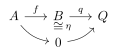 such that:
for every morphism \(B \xrightarrow []{z} Z\) and every isomorphism 2-cell
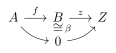 there exist a morphism \(Q \xrightarrow []{u} Z\) and an isomorphism 2-cell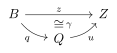
for all morphisms \(u\), \(v\colon Q \to Z\) and every 2-cell
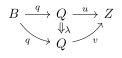 there exists a unique 2-cell \(\mu \colon u \Rightarrow v\) such that \(\mu \star q = \lambda \).
Let \(\mathit{L}\) be a 2-category with a strong bizero object \(0\). A 2-kernel of a morphism \(A\xrightarrow []{f}B\) in \(\mathit{L}\) is a morphism \(K\xrightarrow []{k}A\) together with an isomorphism 2-cell 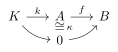 such that:
for every morphism \(Z \xrightarrow []{z} A\) and every isomorphism 2-cell
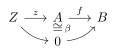 there exist a morphism \(Z \xrightarrow []{u} K\) and an isomorphism 2-cell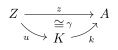
for all morphisms \(u\), \(v\colon Z \to K\) and every 2-cell
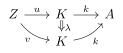 there exists a unique 2-cell \(\mu \colon u \Rightarrow v\) such that \(k \star \mu = \lambda \).
Here \(\star \) denotes the whiskering of a morphism with a 2-cell.
Let \(A\xrightarrow []{f}C\) and \(B\xrightarrow []{g}C\) be morphisms in a 2-category \(\mathit{L}\). A bipullback of \(f\) and \(g\) is an object \(P\) together with morphisms \(P\xrightarrow []{p_1}A\) and \(P\xrightarrow []{p_2}B\) and an isomorphism 2-cell  such that:
for all morphisms \(Z\xrightarrow []{a}A\) and \(Z\xrightarrow []{b}B\) and every isomorphism 2-cell

there exist a morphism \(Z\xrightarrow []{u}P\) and isomorphism 2-cells
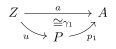 and
and 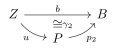
such that \(\psi \) is equal to the pasting
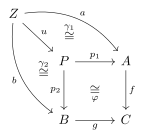
for all morphisms \(u\), \(v\colon Z\to P\) and all 2-cells
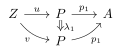 and
and 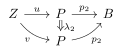
satisfying \((g\star \lambda _2)\cdot (\varphi \star u)=(\varphi \star v)\cdot (f\star \lambda _1)\), there exists a unique 2-cell \(\mu \colon u\Rightarrow v\) such that \(p_1\star \mu =\lambda _1\) and \(p_2\star \mu =\lambda _2\).
The dual notion is that of a bipushout.
Let \(\mathit{L}\) be a 2-category. A bizero object in \(\mathit{L}\) is an object \(0\in \mathit{L}\) such that for every \(A\in \mathit{L}\) both the hom-categories \({\mathit{L}}\left({A},\, {0}\right)\) and \({\mathit{L}}\left({0},\, {A}\right)\) are equivalent to the singleton category \(\mathsf{1}\). This means in particular that there exists a morphism \(A\to 0\) which is unique up to a unique isomorphism, and similarly a morphism \(0\to A\).
We call \(\mathit{L}\) a bipointed 2-category if it has a bizero object.
Let \(\mathit{L}\) be a 2-category with a strong bizero object, and let \(f\) be a morphism in \(\mathit{L}\). We call \(f\) a 2-monomorphism if it is a fully faithful arrow, that is, if for every object \(Z\) the functor \(f\circ (-)\colon {\mathit{L}}\left({Z},\, {A}\right)\to {\mathit{L}}\left({Z},\, {B}\right)\) is fully faithful. Dually, we call \(f\) a 2-epimorphism if it is a cofully faithful arrow.
A morphism \(f\) is normal when it is isomorphic to a composite \(m\circ e\) in which \(m\) is a normal 2-monomorphism and \(e\) is a normal 2-epimorphism. It is antinormal when it is isomorphic to a composite \(e\circ m\) in which \(m\) is a normal 2-monomorphism and \(e\) is a normal 2-epimorphism.
In a 2-z-exact 2-category, a morphism which occurs as a 2-kernel of some morphism is called a normal 2-monomorphism. Dually, a morphism which occurs as a 2-cokernel of some morphism is called a normal 2-epimorphism.
Let \(h\colon B\to C\) be a morphism in a bipointed 2-category. We say that \(h\) reflects null morphisms if whenever a composite \(A\xrightarrow []{f}B\xrightarrow []{h}C\) is isomorphic to a null morphism, then also \(f\) is isomorphic to a null morphism. If \(h\) satisfies the dual condition, we say that \(h\) coreflects null morphisms.
Let \(\mathit{L}\) be a 2-category. A bizero object \(0\) in \(\mathit{L}\) is called strong if given any two parallel morphisms that factor through \(0\) there is a unique 2-cell between them, which is then equal to the isomorphism null 2-cell described in Remark 2.4. 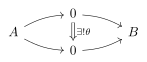
A 2-category \(\mathit{L}\) with a strong bizero object is called 2-di-exact if it satisfies the following two conditions:
\(\mathit{L}\) has all 2-kernels and all 2-cokernels;
every morphism that factorises, up to an invertible 2-cell, as a 2-kernel followed by a 2-cokernel also factorises, up to an invertible 2-cell, as a 2-cokernel followed by a 2-kernel.
An antinormal pair \((m,e)\) consists of a normal 2-monomorphism \(m\colon K\to X\) and a normal 2-epimorphism \(e\colon X\to R\); its antinormal composite is \(e\circ m\). The dinverse of \((m,e)\) is the antinormal pair \((2\text{-}\mathrm{ker}(e),2\text{-}\mathrm{coker}(m))\), and the dinversion of \((m,e)\) is the antinormal composite of its dinverse, namely
the diagonal of the cross
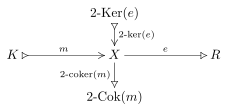
Since \(m\) is the 2-kernel of its 2-cokernel and \(e\) the 2-cokernel of its 2-kernel, by Proposition 3.11, dinversion is involutive: the dinverse of \((2\text{-}\mathrm{ker}(e),2\text{-}\mathrm{coker}(m))\) is again \((m,e)\), up to equivalence.
An antinormal decomposition of the zero map is an antinormal pair \((m,e)\) with \(e\circ m\cong 0\).
A 2-z-exact 2-category satisfies condition \(\textup{(DPN)}\)—dinversion preserves normality—when for every antinormal pair \((m,e)\) the composite \(e\circ m\) is normal if and only if the dinversion \(w=2\text{-}\mathrm{coker}(m)\circ 2\text{-}\mathrm{ker}(e)\) is normal.
A pair \((f,g)\) of composable normal morphisms is exact in \(B\) when the equivalent conditions of Proposition 4.4 hold. A sequence of morphisms
is exact if it is exact in each position where the condition makes sense. In particular, every morphism occurring in an exact sequence is required to be normal.
A normal chain complex \((C,d)\) is a sequence of normal morphisms \(d_n\colon C_n\to C_{n-1}\), for \(n\in \mathbb {Z}\), with \(d_n\circ d_{n+1}\cong 0\). This relation makes \(2\text{-}\mathrm{im}(d_{n+1})\) factor through \(2\text{-}\mathrm{ker}(d_n)\) and, dually, \(2\text{-}\mathrm{coim}(d_n)\) factor through \(2\text{-}\mathrm{coker}(d_{n+1})\). The cokernel homology and kernel homology of \((C,d)\) at position \(n\) are
and
Equivalently, \(\mathrm{H}^{\mathrm{coker}}_{n}(C)=2\text{-}\mathrm{Coim}(w_n)\) and \(\mathrm{H}^{\ker }_{n}(C)=2\text{-}\mathrm{Im}(w_n)\), where
is the dinversion of the antinormal pair \((2\text{-}\mathrm{im}(d_{n+1}),2\text{-}\mathrm{coim}(d_n))\); we write
for the comparison of Lemma 4.2.
Let \((k',q')\) and \((k,q)\) be short 2-exact sequences, with structure 2-cells \(\kappa '\colon q'\circ k'\cong 0\) and \(\kappa \colon q\circ k\cong 0\). A morphism of short 2-exact sequences between them, drawn as 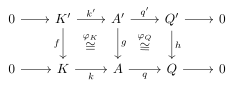 consists of morphisms \(f\colon K'\to K\), \(g\colon A'\to A\) and \(h\colon Q'\to Q\) together with invertible 2-cells
filling the two squares. In the 1-categorical, that is locally discrete, interpretation the 2-cells \(\varphi _K\) and \(\varphi _Q\) are identities, so the two squares commute on the nose.
A morphism of ladders \(p\) between two diagrams of the shape 6.9, as in Figure 1, consists of 1-cells \(p_A\), \(p_B\), \(p_C\), \(p_X\), \(p_Y\), \(p_Z\) together with invertible 2-cells filling the four horizontal squares and the three vertical ones, subject to the compatibility of Lemma 7.4 on each of the two ends.
Let \(\Pi \) and \(\Pi '\) be pure configurations, with data written as above and primed. A morphism of pure configurations \(\pi \colon \Pi \to \Pi '\) consists of a morphism of short 2-exact sequences \((\pi _A,\pi _Y,\pi _C)\) from the top row of \(\Pi \) to the top row of \(\Pi '\) and a morphism of short 2-exact sequences \((\pi _X,\pi _Y,\pi _Z)\) from the bottom row of \(\Pi \) to the bottom row of \(\Pi '\), with the same middle component \(\pi _Y\). We write
for the four filling 2-cells.
A pure configuration is a morphism of short 2-exact sequences whose middle component is an identity: a pair of short 2-exact sequences
through a common object \(Y\), together with 1-cells \(f\colon A\to X\) and \(h\colon C\to Z\) and invertible 2-cells
Its dinversion is \(b\circ c\colon X\to C\).
A sequence of 2-monomorphisms \(A\xrightarrow []{a}X\xrightarrow []{c}B\) is totally normal when \(a\), \(c\) and the composite \(c\circ a\) are all normal 2-monomorphisms. Dually, a sequence of 2-epimorphisms \(X\xrightarrow []{p}Y\xrightarrow []{q}Z\) is totally normal when \(p\), \(q\) and \(q\circ p\) are all normal 2-epimorphisms.
For a morphism \(f\colon A\to B\) in a 2-z-exact 2-category, the following are equivalent:
\(f\) is an equivalence;
\(f\) is both a normal 2-monomorphism and a normal 2-epimorphism;
\(f\) is both a normal 2-monomorphism and a 2-epimorphism;
\(f\) is both a 2-monomorphism and a normal 2-epimorphism.
For a pair \((f,g)\) of composable normal morphisms
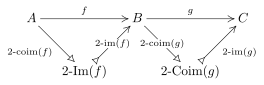
with their respective normal image factorisations, the following conditions are equivalent:
\(2\text{-}\mathrm{im}(f)\simeq 2\text{-}\mathrm{ker}(g)\);
\(2\text{-}\mathrm{coker}(f)\simeq 2\text{-}\mathrm{coim}(g)\);
the pair \((2\text{-}\mathrm{im}(f),2\text{-}\mathrm{coim}(g))\) is a short 2-exact sequence.
In a homologically self-dual 2-category, let \((f,g)\) be a pair of composable normal morphisms with \(g\circ f\cong 0\). Taking the 2-kernel of \(g\) and the 2-cokernel of \(f\), we obtain induced morphisms \(e\) and \(m\) and the 2-image \(H\) of the composite \(2\text{-}\mathrm{coker}(f)\circ 2\text{-}\mathrm{ker}(g)\).
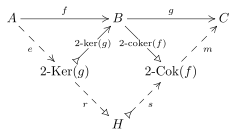
The following conditions are equivalent:
\(e\) is a 2-epimorphism;
\(m\) is a 2-monomorphism;
\((f,g)\) is exact in \(B\);
\(H\) is trivial.
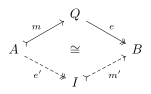
If, in a 2-z-exact 2-category, a morphism \(f\colon A\to B\) factors, up to an invertible 2-cell, as a normal 2-epimorphism \(e\colon A\to I\) followed by a normal 2-monomorphism \(m\colon I\to B\), then this factorisation is unique up to equivalence. We call it the normal image factorisation of \(f\) and write \(I=2\text{-}\mathrm{Im}(f)\), \(m=2\text{-}\mathrm{im}(f)\), and dually \(I=2\text{-}\mathrm{Coim}(f)\), \(e=2\text{-}\mathrm{coim}(f)\).
If \(f\) further factors, up to an invertible 2-cell, as a 2-epimorphism \(e'\colon A\to I'\) followed by a 2-monomorphism \(m'\colon I'\to B\), then necessarily \(e'\) is a normal 2-epimorphism and \(m'\) is a normal 2-monomorphism.
Let \(\mathit{L}\) be a 2-category with a strong bizero object and let \(f\colon A\to B\) be a morphism. A morphism \(k\colon K\to A\) is a 2-kernel of \(f\) if and only if it is, together with the essentially unique morphism \(K\to 0\), a bipullback of \(f\) along a chosen null morphism \(0\to B\). Dually for 2-cokernels and bipushouts.
Let \((m,e)\) be an antinormal pair in a 2-z-exact 2-category, with dinversion \(w=2\text{-}\mathrm{coker}(m)\circ 2\text{-}\mathrm{ker}(e)\). Then \(2\text{-}\mathrm{Cok}(e\circ m)\simeq 2\text{-}\mathrm{Cok}(w)\), and dually \(2\text{-}\mathrm{Ker}(e\circ m)\simeq 2\text{-}\mathrm{Ker}(w)\).
Let \(K\) and \(S\) be Serre subcategories of an abelian category \(\mathsf{A}\). Then the exact functor \(K/(K\cap S)\to \mathsf{A}/S\) induced by the inclusion of \(K\) is fully faithful.
The pair \((r,\overline{\imath })\) is a normal image factorisation of \(\overline{b}\). In particular \(\overline{b}\) is normal, with \(2\text{-}\mathrm{im}(\overline{b})\simeq \overline{\imath }\), and \(2\text{-}\mathrm{Cok}(\overline{b})\simeq 2\text{-}\mathrm{Cok}(\overline{\imath })\).
The 1-cell \(\ell \) is a normal 2-monomorphism, and \(e\) is a normal 2-epimorphism.
A morphism of pure configurations \(\pi \colon \Pi \to \Pi '\) induces unique invertible 2-cells
compatible with \(\theta _f\), \(\theta _h\) and the four filling 2-cells, in the sense that
For elements \(a\), \(b\) of a complete lattice, the transposition \([a\wedge b,a]\to [b,a\vee b]\) is invertible if and only if \(\mathrm{M}(b,a)\) and \(\mathrm{M}^{*}(a,b)\) both hold. In particular, a complete lattice in which both the relation \(\mathrm{M}\) and the relation \(\mathrm{M}^{*}\) are symmetric is transposition-symmetric.
The composite \(e\mathrel {:=}2\text{-}\mathrm{coim}(h)\circ b\colon B\to 2\text{-}\mathrm{Im}(h)\) is a normal 2-epimorphism; the composite \(e\circ 2\text{-}\mathrm{ker}(g)\) is null; and there is a normal 2-epimorphism \(t\colon 2\text{-}\mathrm{Im}(g)\to 2\text{-}\mathrm{Im}(h)\) with
Let \(X\) be a noetherian scheme, let \(\mathcal{F}\) be a coherent sheaf on \(X\) and let \(x\in \operatorname{Ass}\mathcal{F}\). Then \(\mathcal{F}\) has a coherent subsheaf \(\mathcal{G}\) with \(\operatorname{Ass}\mathcal{G}=\{ x\} \).
For a morphism \(q\colon A\to Q\) in a 2-category \(\mathit{L}\), the following conditions are equivalent:
\(q\) is an equivalence;
for every object \(Z\), the functor \((-)\circ q\colon {\mathit{L}}\left({Q},\, {Z}\right)\to {\mathit{L}}\left({A},\, {Z}\right)\) is an equivalence of categories;
for every object \(Z\), the functor \(q\circ (-)\colon {\mathit{L}}\left({Z},\, {A}\right)\to {\mathit{L}}\left({Z},\, {Q}\right)\) is an equivalence of categories.
The morphism \(f\) restricts along \(e\), that is, there is a 1-cell \(f'\colon 2\text{-}\mathrm{Coim}(a)\to X\) with \(f'\circ e\cong f\); and \(f'\) is normal. Dually \(h\) corestricts along \(2\text{-}\mathrm{im}(d)\) to a normal \(h'\).
A normal morphism is an equivalence if and only if its 2-kernel and its 2-cokernel are trivial.
Let \(f\colon A\to B\) be a morphism in a 2-z-exact 2-category. Writing \(2\text{-}\mathrm{coim}(f)=2\text{-}\mathrm{coker}(2\text{-}\mathrm{ker}(f))\) and \(2\text{-}\mathrm{im}(f)=2\text{-}\mathrm{ker}(2\text{-}\mathrm{coker}(f))\), there is a comparison \(j_f\colon 2\text{-}\mathrm{Coim}(f)\to 2\text{-}\mathrm{Im}(f)\), unique up to a unique invertible 2-cell, with \(2\text{-}\mathrm{im}(f)\circ j_f\circ 2\text{-}\mathrm{coim}(f)\cong f\). The morphism \(f\) is normal if and only if \(j_f\) is an equivalence.
Consider a morphism of short 2-exact sequences
in a 2-z-exact 2-category, and assume that \(g\) is normal.
If \(f\) and \(h\) are 2-monomorphisms, then \(g\) is a normal 2-monomorphism.
If \(f\) and \(h\) are 2-epimorphisms, then \(g\) is a normal 2-epimorphism.
If \(f\) and \(h\) are equivalences, then \(g\) is an equivalence.
The abelian category with one object is a strong bizero object of \(\mathit{AbCat}\).
Let \(F\colon \mathsf{A}\to \mathsf{B}\) be an exact functor and let \(S\) be the smallest Serre subcategory of \(\mathsf{B}\) containing the objects \(F(a)\). Then the projection \(q\colon \mathsf{B}\to \mathsf{B}/S\) is a 2-cokernel of \(F\).
In \(\mathit{AbCat}\), normal 2-monomorphisms are closed under composition, and so are normal 2-epimorphisms.
Let \(F\colon \mathsf{A}\to \mathsf{B}\) be an exact functor and let \(K\) be the full subcategory of \(\mathsf{A}\) on the objects that \(F\) annihilates. Then \(K\) is a Serre subcategory of \(\mathsf{A}\) and its inclusion \(k\colon K\to \mathsf{A}\) is a 2-kernel of \(F\).
For a noetherian scheme \(X\), the category \(\mathsf{Coh}(X)\) of coherent sheaves is a noetherian abelian category satisfying \(\textup{(AS)}\).
Let \(\mathit{L}\) be a 2-category with a strong bizero object. In the situation of Definition 3.25,
holds for every choice of \(f\), \(g\), \(h\), \(\varphi _K\) and \(\varphi _Q\). Here \(\star \) denotes whiskering and \(\cdot \) vertical composition, and we identify \(h\circ 0\) with \(0\).
Condition (DI2) holds in \(\mathit{AbCat}\) if and only if for every abelian category \(\mathsf{A}\) and all Serre subcategories \(K\) and \(S\) of \(\mathsf{A}\), the \(S\)-saturation \(K^{S}\) is a Serre subcategory of \(\mathsf{A}\).
A 2-di-exact 2-category satisfies \(\textup{(DPN)}\); and a 2-z-exact 2-category satisfying \(\textup{(DPN)}\) is homologically self-dual.
For closed subspaces \(A\), \(B\) of a Hilbert space \(H\), the transposition \([A\wedge B,A]\to [B,A\vee B]\) of \(\mathrm{L}(H)\) is invertible if and only if both \(A+B\) and \(A^{\perp }+B^{\perp }\) are closed. In particular, every Hilbert lattice is transposition-symmetric.
Suppose \(a=2\text{-}\mathrm{ker}(b)\) and let \(c\) be a 2-monomorphism. Then \(\overline{a}=2\text{-}\mathrm{ker}(\overline{b})\). Dually, if \(d=2\text{-}\mathrm{coker}(c)\) and \(b\) is a 2-epimorphism, then \(\underline{d}=2\text{-}\mathrm{coker}(\underline{c})\).
Let \(e=2\text{-}\mathrm{coim}(a)\), let \(v\colon 2\text{-}\mathrm{Ker}(e)\to 2\text{-}\mathrm{Ker}(f)\) be the comparison induced by \(f\circ 2\text{-}\mathrm{ker}(e)\cong 0\), and let \(f'\) be the restriction of \(f\) along \(e\) of Lemma 6.20. If \(v\) has a 2-cokernel, then the comparison \(\overline{a}''\colon 2\text{-}\mathrm{Ker}(f)\to 2\text{-}\mathrm{Ker}(f')\) is a normal 2-epimorphism. Dually for \(\underline{d}''\).
Let \(R\) be a commutative Noetherian ring. Then the category of finitely generated \(R\)-modules is a noetherian abelian category satisfying \(\textup{(AS)}\).
Normal 2-monomorphisms are stable under bipullback. Precisely, let
be a bipullback in a 2-category with a strong bizero object, let \(g\) be a 2-kernel of \(w\colon C\to W\), and suppose that \(p_1\) is a 2-monomorphism. Then \(p_1\) is a 2-kernel of \(w\circ f\); in particular it is a normal 2-monomorphism.
The composite \(2\text{-}\mathrm{coker}(g)\circ c\) is normal; its normal image factorisation may be written \(\mu \circ 2\text{-}\mathrm{coker}(\kappa )\) with \(\mu \colon 2\text{-}\mathrm{Cok}(\kappa )\to 2\text{-}\mathrm{Cok}(g)\) a normal 2-monomorphism. The morphism \(\underline{c}\) is normal.
There is a morphism \(\kappa \colon 2\text{-}\mathrm{Ker}(t)\to X\), essentially unique with the property \(c\circ \kappa \cong 2\text{-}\mathrm{im}(g)\circ 2\text{-}\mathrm{ker}(t)\), and it is a 2-kernel of \(2\text{-}\mathrm{coker}(g)\circ c\). In particular \(\kappa \) is a normal 2-monomorphism.
Let \(b\) be a 2-cokernel of \(a\), let \(b\circ k\cong i\circ r\) with \(r\) a 2-epimorphism, let \(q\) be a 2-cokernel of \(i\) and let \(p\) be a 2-cokernel of \(k\). If \(e\) is a 2-epimorphism, then \(\pi \) is a 2-cokernel of \(\ell \).
The class \(K^{S}\) contains \(K\) and \(S\), is closed under subobjects and under quotients, and is contained in every Serre subcategory of \(\mathsf{A}\) containing \(K\) and \(S\). It is therefore a Serre subcategory if and only if it is the join \(K\vee S\).
Let \(q'\) be a 2-cokernel of \(\overline{b}\), let \(z\) be an equivalence, let \(m\) be a 2-kernel of \(\underline{c}\), and put \(\partial =m\circ z\circ q'\). Then the pair \((\partial ,\underline{c})\) is 2-exact at \(2\text{-}\mathrm{Cok}(f)\); and if \(\overline{b}\) is normal, the pair \((\overline{b},\partial )\) is 2-exact at \(2\text{-}\mathrm{Ker}(h)\).
Up to composition with isomorphisms on either side, the antinormal morphisms of \(\mathit{Sup}\) are the maps
for elements \(a\), \(b\) of a complete lattice \(L\); and \(c_{a,b}\) is normal if and only if the transposition
is an isomorphism.
Let \(\mathcal{C}\) be a class of complete lattices, closed under isomorphism, containing a one-element lattice, and such that every interval of a member of \(\mathcal{C}\) belongs to \(\mathcal{C}\). The full sub-2-category \(\mathit{Sup}_{\mathcal{C}}\) of \(\mathit{Sup}\) on \(\mathcal{C}\) is then 2-z-exact with a strong bizero object; Corollary 8.34 and Proposition 8.35 describe its normal 2-monomorphisms, its normal 2-epimorphisms and its antinormal morphisms, and both closure properties of Corollary 8.34 hold in it. Moreover, \(\mathit{Sup}_{\mathcal{C}}\) satisfies condition (DI2) if and only if every member of \(\mathcal{C}\) is modular, and condition \(\textup{(DPN)}\) if and only if every member of \(\mathcal{C}\) is transposition-symmetric.
- SnakeLean.LatticeClass
- SnakeLean.twoDiExact_of_forall_isModularLattice
- SnakeLean.isModularLattice_of_twoDiExact
- SnakeLean.twoDiExact_iff_forall_isModularLattice
- SnakeLean.dpn_of_forall_transpositionSymmetric
- SnakeLean.transpositionSymmetric_of_dpn
- SnakeLean.dpn_iff_forall_transpositionSymmetric
- SnakeLean.normalEpiCompSup
- SnakeLean.normalMonoCompSup
The 2-category \(\mathit{Sup}\) is 2-z-exact. Explicitly, for a join-preserving map \(f\colon L\to M\), a 2-kernel of \(f\) is the inclusion of the down-segment \({\downarrow }a=\{ x\in L\mid x\leq a\} \) for \(a=\bigvee \{ x\in L\mid f(x)=\bot \} \), and a 2-cokernel of \(f\) is the map \(q_{s}\colon M\to {\uparrow }s=\{ y\in M\mid s\leq y\} \colon y\mapsto y\vee s\) for \(s=f(\top )\).
For a complete lattice \(L\) the following conditions are equivalent:
\(L\) is modular;
for all \(a\), \(b\in L\), the antinormal morphism \(c_{a,b}\) is normal.
Let \(A\xrightarrow []{a}B\xrightarrow []{b}C\) be a short 2-exact sequence in a 2-z-exact 2-category satisfying \(\textup{(DPN)}\), and let \(g\colon B\to Y\) be a morphism. Then \(b\circ 2\text{-}\mathrm{ker}(g)\) is normal if and only if \(2\text{-}\mathrm{coim}(g)\circ a\) is.
In a 2-category with a strong bizero object, 2-kernels are 2-monomorphisms and 2-cokernels are 2-epimorphisms.
In a 2-category with a strong bizero object, every 2-monomorphism reflects null morphisms. Dually, every 2-epimorphism coreflects null morphisms.
In a homologically self-dual 2-category, a morphism of short 2-exact sequences with identity middle component
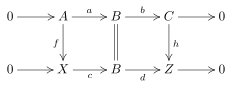
induces the 2-exact sequence

In particular \(f\) is a normal 2-monomorphism and \(h\) is a normal 2-epimorphism, and the comparison
is an equivalence, unique up to a unique invertible 2-cell with that property.
A short 2-exact sequence is a pair of composable morphisms \(k\colon K\to A\) and \(q\colon A\to Q\) such that \(k\) is a 2-kernel of \(q\) and \(q\) is a 2-cokernel of \(k\). We write \(\kappa \colon q\circ k\cong 0\) for the invertible 2-cell exhibiting both, and picture the situation as

In a di-exact category, consider a commutative diagram
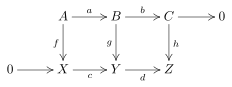
in which \(f\), \(g\) and \(h\) are normal. If the horizontal rows are exact, then there is a morphism \(\partial \colon \mathrm{Ker}(h)\to \mathrm{Cok}(f)\) making the sequence
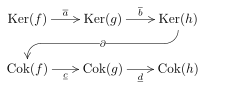
exact. If moreover \(a=\ker (b)\), then \(\overline{a}=\ker (\overline{b})\); dually, if \(d=\mathrm{coker}(c)\), then \(\underline{d}=\mathrm{coker}(\underline{c})\).
In a 2-di-exact 2-category, consider a diagram
whose two squares commute up to invertible 2-cells \(\varphi \colon g\circ a\cong c\circ f\) and \(\psi \colon h\circ b\cong d\circ g\), and in which \(f\), \(g\) and \(h\) are normal. If the horizontal rows are 2-exact, then there exists a 1-cell \(\partial \) such that the sequence
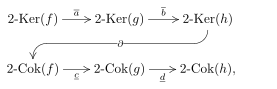
in which \(\overline{a}\) and \(\overline{b}\) are induced by taking 2-kernels and \(\underline{c}\) and \(\underline{d}\) by taking 2-cokernels, is 2-exact.
If, moreover, \(a=2\text{-}\mathrm{ker}(b)\), then \(\overline{a}=2\text{-}\mathrm{ker}(\overline{b})\); dually, if \(d=2\text{-}\mathrm{coker}(c)\), then \(\underline{d}=2\text{-}\mathrm{coker}(\underline{c})\).
The 2-category \(\mathit{Sup}_{\mathrm{hil}}\) of Hilbert lattices is 2-z-exact with a strong bizero object, its normal 2-monomorphisms and its normal 2-epimorphisms are closed under composition, and it satisfies condition \(\textup{(DPN)}\); but it is not 2-di-exact. The Snake Lemma holds in \(\mathit{Sup}_{\mathrm{hil}}\) in the form of Theorem 9.19, while Theorem 6.9 does not apply to it.
The locally ordered 2-category \(\mathit{Sup}_{\mathrm{mod}}\) of complete modular lattices and join-preserving maps is 2-di-exact.
Let \(\pi \colon \Pi \to \Pi '\) be a morphism of pure configurations in a homologically self-dual 2-category. Then there is a unique invertible 2-cell
compatible with the characterising 2-cells of \(j_\Pi \) and \(j_{\Pi '}\), in the sense that whiskering \(\nu _\pi \) by \(2\text{-}\mathrm{coker}(f)\) on the right and by \(2\text{-}\mathrm{ker}(h')\) on the left produces the identity 2-cell of \(\pi _C\circ b\circ c\) under the two pastings displayed in the proof.
Let \(p\) be a morphism of ladders between two diagrams satisfying the hypotheses of Theorem 6.9. Then \(p\) induces 1-cells
on the 2-kernels of \(f\), \(g\), \(h\) and the 2-cokernels of \(f\), \(g\), \(h\) respectively, and the resulting ladder
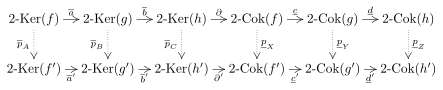
commutes up to invertible 2-cells. In particular there is an invertible 2-cell
The 2-category \(\mathit{Sat}\) of saturated abelian categories, exact functors and natural transformations is 2-di-exact.
Let \(\mathit{L}\) be a 2-z-exact 2-category with a strong bizero object which satisfies \(\textup{(DPN)}\) and \(\textup{(NEC)}\). Then the conclusion of Theorem 6.9 holds: for every diagram 6.9 with 2-exact rows whose two squares commute up to invertible 2-cells and whose verticals \(f\), \(g\) and \(h\) are normal, there is a 1-cell \(\partial \) making the sequence 6.9 2-exact; and if \(a=2\text{-}\mathrm{ker}(b)\) then \(\overline{a}=2\text{-}\mathrm{ker}(\overline{b})\), dually for \(\underline{d}\).
The same holds if \(\textup{(NEC)}\) is replaced by its dual, that normal 2-monomorphisms be closed under composition.
For a 2-z-exact 2-category the following conditions are equivalent.
The 2-category is homologically self-dual.
For every totally normal sequence of 2-monomorphisms \(A\xrightarrow []{a}X\xrightarrow []{c}B\), the induced sequence
\[ 2\text{-}\mathrm{Cok}(a)\longrightarrow 2\text{-}\mathrm{Cok}(c\circ a)\longrightarrow 2\text{-}\mathrm{Cok}(c) \]is short 2-exact.
For every totally normal sequence of 2-epimorphisms \(X\xrightarrow []{p}Y\xrightarrow []{q}Z\), the induced sequence
\[ 2\text{-}\mathrm{Ker}(p)\longrightarrow 2\text{-}\mathrm{Ker}(q\circ p)\longrightarrow 2\text{-}\mathrm{Ker}(q) \]is short 2-exact.
Let \(f\colon A\to B\) be a normal morphism in a 2-z-exact 2-category, say \(f\cong m\circ e\) with \(e\) a normal 2-epimorphism and \(m\) a normal 2-monomorphism. If the 2-kernel of \(f\) is trivial, then \(e\) is an equivalence, and hence \(f\) is a normal 2-monomorphism. Dually, if the 2-cokernel of \(f\) is trivial, then \(m\) is an equivalence, and hence \(f\) is a normal 2-epimorphism.