3 2-kernels, 2-cokernels and normality
3.1 2-z-exactness and normality
A 2-z-exact 2-category is a 2-category with a strong bizero object that has all 2-kernels and all 2-cokernels.
In a 2-z-exact 2-category, a morphism which occurs as a 2-kernel of some morphism is called a normal 2-monomorphism. Dually, a morphism which occurs as a 2-cokernel of some morphism is called a normal 2-epimorphism.
A morphism \(f\) is normal when it is isomorphic to a composite \(m\circ e\) in which \(m\) is a normal 2-monomorphism and \(e\) is a normal 2-epimorphism. It is antinormal when it is isomorphic to a composite \(e\circ m\) in which \(m\) is a normal 2-monomorphism and \(e\) is a normal 2-epimorphism.
3.5 Composition and cancellation
Let \(f\colon A\to B\), \(g\colon B\to C\) and \(h\colon A\to C\) be morphisms in a 2-z-exact 2-category, and assume that \(h\) is isomorphic to \(g\circ f\). Then:
if \(h\) is a 2-monomorphism and \(g\) is faithful, then \(f\) is a 2-monomorphism;
if \(g\) is a 2-monomorphism and \(h\) is a normal 2-monomorphism, then \(f\) is a normal 2-monomorphism.
We prove \((i)\). Consider a pair of morphisms \(u\), \(v\colon Q\to A\) and a 2-cell \(\lambda \colon f\circ u\Longrightarrow f\circ v\). We must show that there is a unique 2-cell \(\xi \colon u\Longrightarrow v\) with \(f\star \xi =\lambda \). Starting from \(\lambda \) we form the following pasting: 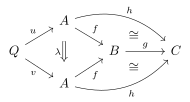 Since \(h\) is a fully faithful arrow, there is a unique 2-cell \(\varphi \colon u\Longrightarrow v\) such that \(h\star \varphi \) coincides with this pasting. Then \(f\star \varphi =\lambda \): as \(g\) is faithful it suffices to check this after postcomposing with \(g\), and there it holds, by pasting with the given invertible 2-cell \(h\cong g\circ f\). Moreover \(\varphi \) is the unique such 2-cell, since any two 2-cells \(\xi \) with \(f\star \xi =\lambda \) have equal whiskerings with \(h\), and \(h\) is faithful.
We now prove \((ii)\). Say \(h\) is the 2-kernel of \(\ell \colon C\to D\); we prove that \(f\) is the 2-kernel of \(\ell \circ g\). The 2-dimensional universal property is \((i)\), a 2-monomorphism being in particular faithful. For the 1-dimensional one, note first that \(g\circ f\) is a 2-kernel of \(\ell \), by Corollary 2.22; in particular \(\ell \circ g\circ f\) is isomorphic to a null morphism. Let \(r\colon M\to B\) be such that \((\ell \circ g)\circ r\) is isomorphic to a null morphism. Since \(g\circ f\) is the 2-kernel of \(\ell \), there are \(s\colon M\to A\) and an invertible 2-cell \(\beta \colon g\circ f\circ s\cong g\circ r\); as \(g\) is fully faithful, \(\beta \) lifts to an invertible 2-cell \(f\circ s\cong r\). So \(f\) satisfies the universal property of the 2-kernel of \(\ell \circ g\).
Part \((i)\) asks of \(g\) only faithfulness, and its proof uses no more: fullness of \(g\) never enters. Part \((ii)\) admits no such weakening, since it lifts an invertible 2-cell \(\beta \) along \(g\), which is exactly fullness.
In a 2-z-exact 2-category, the composite of a normal 2-monomorphism with an equivalence, on either side, is again a normal 2-monomorphism; dually for normal 2-epimorphisms. Consequently a morphism isomorphic to \(v\circ w\circ u\), with \(u\) and \(v\) equivalences, is normal if and only if \(w\) is, and antinormal if and only if \(w\) is.
Let \(k\colon K\to A\) be a 2-kernel of \(f\colon A\to B\), let \(u\colon K'\to K\) and \(w\colon A\to A'\) be equivalences and let \(w'\) be a quasi-inverse of \(w\). We claim that \(w\circ k\circ u\) is a 2-kernel of \(f\circ w'\). It is a 2-monomorphism, being a composite of 2-monomorphisms, so condition \((2)\) of Definition 2.18 holds; and \(f\circ w'\circ w\circ k\circ u\cong f\circ k\circ u\) is null. If \(z\colon Z\to A'\) satisfies \(f\circ w'\circ z\cong 0\), then the universal property of \(k\) yields \(s\colon Z\to K\) with \(w'\circ z\cong k\circ s\), whence \(z\cong w\circ k\circ s\cong (w\circ k\circ u)\circ (u'\circ s)\) for a quasi-inverse \(u'\) of \(u\). This proves the first assertion, since every equivalence is invertible up to isomorphism on either side; the second is dual.
For the consequence, let \(w\cong m\circ e\) be normal. Then \(v\circ w\circ u\cong (v\circ m)\circ (e\circ u)\) is a normal 2-monomorphism after a normal 2-epimorphism, hence normal; and the converse follows by composing with quasi-inverses. The same computation applies with the factors interchanged, which is antinormality.
In a 2-category with a strong bizero object, if a morphism \(f\) is isomorphic to a composite \(m\circ g\) with \(m\) a 2-monomorphism, then \(2\text{-}\mathrm{ker}(f)\simeq 2\text{-}\mathrm{ker}(g)\). Dually, if \(f\) is isomorphic to a composite \(g'\circ e\) with \(e\) a 2-epimorphism, then \(2\text{-}\mathrm{coker}(f)\simeq 2\text{-}\mathrm{coker}(g')\).
In particular, if \(f\) is isomorphic to a composite \(m\circ e\) in which \(m\) is a 2-monomorphism and \(e\) is a 2-epimorphism, then \(2\text{-}\mathrm{coker}(f)\simeq 2\text{-}\mathrm{coker}(m)\) and \(2\text{-}\mathrm{ker}(f)\simeq 2\text{-}\mathrm{ker}(e)\).
Say \(f\colon A\to B\), \(g\colon A\to Q\) and \(m\colon Q\to B\). Consider the 2-kernel \(K\xrightarrow []{k}A\) of \(g\). Certainly \(f\circ k\) is isomorphic to a null morphism, since \(g\circ k\) is. Let \(r\colon M\to A\) be a morphism such that \(f\circ r\) is isomorphic to a null morphism. Then so is \(m\circ g\circ r\), and \(m\) reflects null morphisms by Proposition 2.16, so \(g\circ r\) is isomorphic to a null morphism as well. The universal property of the 2-kernel of \(g\) now yields \(s\colon M\to K\) and an invertible 2-cell \(r\cong k\circ s\). Since \(k=2\text{-}\mathrm{ker}(g)\) is a 2-monomorphism, this exhibits \(k\) as a 2-kernel of \(f\).
Conversely, consider the 2-kernel \(H\xrightarrow []{h}A\) of \(f\). Since \(f\circ h\) is isomorphic to a null morphism, so is \(m\circ g\circ h\), and hence so is \(g\circ h\), again by Proposition 2.16. That \(h\) is a 2-kernel of \(g\) now follows in the same way, the 2-dimensional universal property being automatic since \(h\) is a 2-kernel of \(f\). The second part of the statement is dual.
3.10 Short 2-exact sequences
In a 2-z-exact 2-category, any normal 2-epimorphism is a 2-cokernel of its 2-kernel; any normal 2-monomorphism is a 2-kernel of its 2-cokernel.
We prove the first statement; the second follows by duality. Let \(q\colon B\to Q\) be a 2-cokernel of a morphism \(f\colon A\to B\), with invertible 2-cell \(\eta \colon q\circ f\cong 0\), and let \((k\colon K\to B,\ \kappa \colon q\circ k\cong 0)\) be the 2-kernel of \(q\). We verify that \((q,\kappa )\) is a 2-cokernel of \(k\).
Condition (1) of Definition 2.18, applied to the datum \((f,\eta )\), provides a morphism \(w\colon A\to K\) and an invertible 2-cell \(\gamma \colon k\circ w\cong f\). Let now \(z\colon B\to Z\) be a morphism with an invertible 2-cell \(\beta \colon z\circ k\cong 0\). Then \((\beta \star w)\cdot (z\star \gamma ^{-1})\colon z\circ f\cong 0\) is invertible, so condition (1) of Definition 2.19 applied to \(q\) yields a morphism \(u\colon Q\to Z\) and an invertible 2-cell \(u\circ q\cong z\). This is condition (1) for the 2-cokernel of \(k\). Condition (2) for the 2-cokernel of \(k\) is literally condition (2) of \(q=2\text{-}\mathrm{coker}(f)\). Hence \(q\) is a 2-cokernel of \(k\).
A short 2-exact sequence is a pair of composable morphisms \(k\colon K\to A\) and \(q\colon A\to Q\) such that \(k\) is a 2-kernel of \(q\) and \(q\) is a 2-cokernel of \(k\). We write \(\kappa \colon q\circ k\cong 0\) for the invertible 2-cell exhibiting both, and picture the situation as

By Proposition 3.11, if \(m\colon A\to B\) is a normal 2-monomorphism with 2-cokernel \(2\text{-}\mathrm{coker}(m)\colon B\to C\), then \(A\xrightarrow []{m}B\xrightarrow []{2\text{-}\mathrm{coker}(m)}C\) is a short 2-exact sequence; dually for a normal 2-epimorphism and its 2-kernel.
Let \(\mathit{LAdj}\) be the 2-category whose objects are the pointed finitely cocomplete categories, whose 1-cells are the left adjoints between them and whose 2-cells are the natural transformations. Its trivial category is a strong bizero object: a null 1-cell is a functor constant at the zero object, and between two such there is exactly one natural transformation, the zero object having a single endomorphism. Every reflector \(r\colon \mathsf{A}\to \mathsf{B}\) onto a full replete subcategory is a 2-epimorphism of \(\mathit{LAdj}\). Indeed, write \(i\) for its fully faithful right adjoint; the unit \(\eta _{A}\colon A\to irA\) is inverted by \(r\), so a natural transformation \(\theta \colon F\circ r\Rightarrow G\circ r\) is determined by its whiskering \(\theta \star i\), and precomposition with \(r\) is fully faithful.
Take the abelianisation \(\mathrm{ab}\colon \mathsf{Grp}\to \mathsf{Ab}\colon G\mapsto G/[G,G]\), the reflector onto the abelian groups. Its 2-kernel is the category \(\mathsf{Perf}\) of perfect groups, those with \(G=[G,G]\), included by \(\kappa \colon \mathsf{Perf}\to \mathsf{Grp}\). That inclusion is a 1-cell of \(\mathit{LAdj}\), being left adjoint to the perfect radical \(G\mapsto pG\), the largest perfect subgroup of \(G\); a homomorphic image of a perfect group is perfect, so every morphism from a perfect group into \(G\) lands in \(pG\). For the universal property, a 1-cell \(z\colon \mathsf{Z}\to \mathsf{Grp}\) carries an invertible 2-cell \(\mathrm{ab}\circ z\cong 0\) precisely when every \(z(Z)\) is perfect, in which case \(z\) corestricts to \(w\colon \mathsf{Z}\to \mathsf{Perf}\) with \(\kappa \circ w=z\); and \(w\) is again a left adjoint, its right adjoint being \(\kappa \) followed by the right adjoint of \(z\). As \(\kappa \) is fully faithful, this corestriction is unique up to a unique invertible 2-cell.
Yet \(\mathrm{ab}\) is not a 2-cokernel of \(\kappa \). Let \(F\colon \mathsf{Grp}\to \mathsf{Nil}_{2}\colon G\mapsto G/\gamma _{3}(G)\), be the reflector onto the groups of nilpotency class at most two. A perfect group coincides with every term of its lower central series, so \(F\circ \kappa \cong 0\). Were \(\mathrm{ab}\) a 2-cokernel of \(\kappa \), the 1-cell \(F\) would factor as \(U\circ \mathrm{ab}\) for some \(U\colon \mathsf{Ab}\to \mathsf{Nil}_{2}\), and any two groups with isomorphic abelianisations would have isomorphic images under \(F\). They need not: the free group of rank two and the free abelian group of rank two both abelianise to \(\mathbb {Z}^{2}\), while the second is sent by \(F\) to \(\mathbb {Z}^{2}\) and the first to the free nilpotent group of class two and rank two, which is not abelian.
A 2-cokernel of \(\kappa \) exists nonetheless, and it is the hypoabelianisation
Perfect groups are closed under extensions: if \(N\) contains \(pG\) with \(N/pG\) perfect, then \(N=[N,N]\cdot pG\), while \(pG=[pG,pG]\subseteq [N,N]\), so that \(N=[N,N]\). Hence \(G/pG\) has trivial perfect radical, and the groups with that property—those whose transfinite derived series reaches the trivial group—are the hypoabelian ones, onto which \(h\) is the reflector. It annihilates \(\kappa \), a perfect group being its own perfect radical. It is universal as well: the perfect radical is characteristic, so \(G\to G/pG\) is a cokernel of the inclusion \(pG\to G\), and a 1-cell \(g\) with \(g\circ \kappa \cong 0\) preserves cokernels and therefore sends every unit of \(h\) to an isomorphism, so that it factors through \(h\), uniquely up to a unique invertible 2-cell. Thus

is a short 2-exact sequence, whereas the pair \((\kappa ,\mathrm{ab})\) is not, although \(\kappa \) is a 2-kernel of \(\mathrm{ab}\) and \(\mathrm{ab}\) is a 2-epimorphism. Since \(pG\subseteq [G,G]\), the abelianisation factors through the hypoabelianisation, by a comparison \(\mathsf{HypAb}\to \mathsf{Ab}\) which is far from an equivalence: a free group is residually nilpotent, hence hypoabelian.
What separates the two 2-epimorphisms is an iteration. The reflector \(\mathrm{ab}\) divides out the commutator subgroup once, and the 2-cokernel divides out the transfinite derived series, which is where that operation converges. The argument just given uses nothing about groups beyond the closure of \(\mathsf{Perf}\) under extensions, so it applies to any reflector whose annihilated objects are closed under extensions: such a reflector is a 2-cokernel of its own 2-kernel exactly when its radical is idempotent.
For a short 2-exact sequence 3.12 in a 2-z-exact 2-category, the object \(K\) is trivial if and only if \(q\) is an equivalence. Dually, \(Q\) is trivial if and only if \(k\) is an equivalence.
We prove the first equivalence; the second is dual.
Suppose \(K\) is trivial, so that \(\operatorname {id}_{K}\cong 0\) and hence \(k=k\circ \operatorname {id}_{K}\) is isomorphic to a null morphism. Then for every \(z\colon A\to Z\) the composite \(z\circ k\) is isomorphic to a null morphism, so condition (1) of Definition 2.19 yields \(u\colon Q\to Z\) with \(u\circ q\cong z\); this says that \((-)\circ q\colon {\mathit{L}}\left({Q},\, {Z}\right)\to {\mathit{L}}\left({A},\, {Z}\right)\) is essentially surjective. Condition (2) says that it is fully faithful. As this holds for every \(Z\), Lemma 2.15 makes \(q\) an equivalence.
Conversely, suppose \(q\) is an equivalence, with quasi-inverse \(p\). Whiskering \(\kappa \colon q\circ k\cong 0\) with \(p\) gives \(p\circ q\circ k\cong 0\), whence \(k\) is isomorphic to a null morphism. Now \(k\) is a 2-kernel, so a 2-monomorphism by Proposition 2.21, and therefore reflects null morphisms; applied to \(k\circ \operatorname {id}_{K}=k\) this gives \(\operatorname {id}_{K}\cong 0\), that is, \(K\) is trivial.
Let \(f\colon A\to B\) be a normal morphism in a 2-z-exact 2-category, say \(f\cong m\circ e\) with \(e\) a normal 2-epimorphism and \(m\) a normal 2-monomorphism. If the 2-kernel of \(f\) is trivial, then \(e\) is an equivalence, and hence \(f\) is a normal 2-monomorphism. Dually, if the 2-cokernel of \(f\) is trivial, then \(m\) is an equivalence, and hence \(f\) is a normal 2-epimorphism.
We prove the first statement; the second is dual. By Proposition 3.9 we have \(2\text{-}\mathrm{ker}(f)\simeq 2\text{-}\mathrm{ker}(e)\), so the 2-kernel of \(e\) is trivial. As \(e\) is a normal 2-epimorphism it is the 2-cokernel of its 2-kernel, by Proposition 3.11, so that \(2\text{-}\mathrm{ker}(e)\) and \(e\) form a short 2-exact sequence. Proposition 3.15 applied to that sequence shows \(e\) to be an equivalence, whence \(f\cong m\) is a normal 2-monomorphism.
In a 2-z-exact 2-category, a normal 2-epimorphism that is a 2-monomorphism is an equivalence. Dually, a normal 2-monomorphism that is a 2-epimorphism is an equivalence.
Let \(q\colon A\to Q\) be a 2-cokernel of \(g\colon G\to A\), with \(\eta \colon q\circ g\cong 0\), and suppose \(q\) is a 2-monomorphism. Then \(q\) reflects null morphisms by Proposition 2.16, so \(g\) is isomorphic to a null morphism. Hence \(\operatorname {id}_{A}\circ g\) is isomorphic to a null morphism, and condition (1) of Definition 2.19 yields \(u\colon Q\to A\) with \(u\circ q\cong \operatorname {id}_{A}\). Whiskering with \(q\) gives \(q\circ u\circ q\cong q\cong \operatorname {id}_{Q}\circ q\), and \(q\), being a 2-cokernel, is a 2-epimorphism by Proposition 2.21; so \(q\circ u\cong \operatorname {id}_{Q}\) by the dual of Remark 2.14. Thus \(q\) is an equivalence. The second statement is dual.
For a morphism \(f\colon A\to B\) in a 2-z-exact 2-category, the following are equivalent:
\(f\) is an equivalence;
\(f\) is both a normal 2-monomorphism and a normal 2-epimorphism;
\(f\) is both a normal 2-monomorphism and a 2-epimorphism;
\(f\) is both a 2-monomorphism and a normal 2-epimorphism.
We prove \((i)\Rightarrow (ii)\). The identity \(\operatorname {id}_{B}\) is a 2-kernel of any chosen null morphism \(t\colon B\to 0\): the composite \(t\circ \operatorname {id}_{B}\) is null, every morphism factors through the identity, and \(\operatorname {id}_{B}\) is fully faithful. By Corollary 2.22 the equivalence \(f\) is therefore a 2-kernel of \(t\) as well, and dually a 2-cokernel of any chosen null morphism \(0\to A\). Clearly \((ii)\) implies both \((iii)\) and \((iv)\), and Proposition 3.17 shows that either of these implies \((i)\).
For a morphism \(f\) in a 2-z-exact 2-category, the following are equivalent:
\(f\) is a normal 2-monomorphism;
\(f\) is a 2-monomorphism and it is normal.
A normal morphism is an equivalence if and only if its 2-kernel and its 2-cokernel are trivial.
An equivalence is both a 2-monomorphism and a 2-epimorphism, so its 2-kernel and 2-cokernel are trivial by Lemma 2.24. Conversely, let \(f\cong m\circ e\) be normal with trivial 2-kernel and trivial 2-cokernel. By Corollary 3.16, triviality of the 2-kernel makes \(e\) an equivalence and triviality of the 2-cokernel makes \(m\) an equivalence; hence so is \(f\).
3.21 The normal image factorisation
If, in a 2-z-exact 2-category, a morphism \(f\colon A\to B\) factors, up to an invertible 2-cell, as a normal 2-epimorphism \(e\colon A\to I\) followed by a normal 2-monomorphism \(m\colon I\to B\), then this factorisation is unique up to equivalence. We call it the normal image factorisation of \(f\) and write \(I=2\text{-}\mathrm{Im}(f)\), \(m=2\text{-}\mathrm{im}(f)\), and dually \(I=2\text{-}\mathrm{Coim}(f)\), \(e=2\text{-}\mathrm{coim}(f)\).
If \(f\) further factors, up to an invertible 2-cell, as a 2-epimorphism \(e'\colon A\to I'\) followed by a 2-monomorphism \(m'\colon I'\to B\), then necessarily \(e'\) is a normal 2-epimorphism and \(m'\) is a normal 2-monomorphism.
Suppose \(f\cong m\circ e\) and \(f\cong m'\circ e'\) as stated. Consider the 2-kernel \(K\xrightarrow []{k}A\) of \(f\), which is a 2-kernel of \(e\) by Proposition 3.9; so \(e\) is a 2-cokernel of \(k\), by Proposition 3.11. Since \(m'\circ e'\circ k\) is isomorphic to a null morphism and \(m'\) is a 2-monomorphism, Proposition 2.16 gives that \(e'\circ k\) is isomorphic to a null morphism too. The universal property of the 2-cokernel \(e\) of \(k\) now yields a morphism \(t\colon I\to I'\) and an invertible 2-cell \(\gamma \colon e'\cong t\circ e\). Moreover, since \(e\) is cofully faithful, the pasting 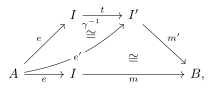 in which the invertible 2-cell on the right is the composite \(m'\circ e'\cong f\cong m\circ e\), induces an invertible 2-cell \(\sigma \colon m'\circ t\cong m\). The situation is this:
 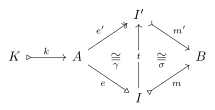 By part (ii) of Proposition 3.6, since \(m\) is a normal 2-monomorphism and \(m'\) is a 2-monomorphism, \(t\) is a normal 2-monomorphism; and by the dual of part (i), since \(e\) and \(e'\) are 2-epimorphisms, \(t\) is a 2-epimorphism. So \(t\) is an equivalence by Corollary 3.18, and the two factorisations agree up to equivalence.
In the course of this argument we assumed of \(m'\) and \(e'\) only that they are a 2-monomorphism and a 2-epimorphism. Since \(t\) is an equivalence, Corollary 2.22 makes \(m'\) a normal 2-monomorphism and \(e'\) a normal 2-epimorphism.
Let \(u\colon A\to B\) be a morphism of a 2-z-exact 2-category and let \(m\colon B\to C\) be a 2-monomorphism. If \(m\circ u\) is normal, then \(u\) is normal. Dually, if \(e\colon A\to B\) is a 2-epimorphism and \(u\circ e\) is normal, then \(u\) is normal.
Let \(m\circ u\cong n\circ p\) be a normal image factorisation. By Proposition 3.9, applied to \(m\circ u\) with the 2-monomorphism \(m\) and to \(n\circ p\) with the 2-monomorphism \(n\), the morphisms \(u\), \(m\circ u\) and \(p\) all have the same 2-kernel \(k\); and \(p\), being a normal 2-epimorphism, is a 2-cokernel of \(k\), by Proposition 3.11. Since \(u\circ k\cong 0\), the universal property of \(p\) yields \(u'\) with \(u'\circ p\cong u\). Then \(m\circ u'\circ p\cong m\circ u\cong n\circ p\), and \(p\) is a 2-epimorphism, so \(m\circ u'\cong n\); as \(n\) is a normal 2-monomorphism and \(m\) is a 2-monomorphism, part (ii) of Proposition 3.6 makes \(u'\) a normal 2-monomorphism. Hence \(u\cong u'\circ p\) is a normal 2-epimorphism followed by a normal 2-monomorphism, so normal.
3.24 Morphisms of short 2-exact sequences
Let \((k',q')\) and \((k,q)\) be short 2-exact sequences, with structure 2-cells \(\kappa '\colon q'\circ k'\cong 0\) and \(\kappa \colon q\circ k\cong 0\). A morphism of short 2-exact sequences between them, drawn as 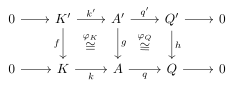 consists of morphisms \(f\colon K'\to K\), \(g\colon A'\to A\) and \(h\colon Q'\to Q\) together with invertible 2-cells
filling the two squares. In the 1-categorical, that is locally discrete, interpretation the 2-cells \(\varphi _K\) and \(\varphi _Q\) are identities, so the two squares commute on the nose.
Let \(\mathit{L}\) be a 2-category with a strong bizero object. In the situation of Definition 3.25,
holds for every choice of \(f\), \(g\), \(h\), \(\varphi _K\) and \(\varphi _Q\). Here \(\star \) denotes whiskering and \(\cdot \) vertical composition, and we identify \(h\circ 0\) with \(0\).
Whiskering an invertible 2-cell with a morphism yields an invertible 2-cell, and a vertical composite of invertible 2-cells is invertible. Both sides of 3 are therefore invertible 2-cells \(q\circ g\circ k'\Longrightarrow 0\) with the same domain and the same null codomain. By Lemma 2.6 they coincide.
3.27 The Normal Short Five Lemma
Consider a morphism of short 2-exact sequences
in a 2-z-exact 2-category, and assume that \(g\) is normal.
If \(f\) and \(h\) are 2-monomorphisms, then \(g\) is a normal 2-monomorphism.
If \(f\) and \(h\) are 2-epimorphisms, then \(g\) is a normal 2-epimorphism.
If \(f\) and \(h\) are equivalences, then \(g\) is an equivalence.
We prove (1). Write \(n\colon N\to A'\) for \(2\text{-}\mathrm{ker}(g)\), so that \(g\circ n\cong 0\). Postcomposing with \(q\) and using \(\varphi _Q\colon h\circ q'\cong q\circ g\) gives \(h\circ q'\circ n\cong 0\); as \(h\) is a 2-monomorphism it reflects null morphisms, so \(q'\circ n\cong 0\). Since \(k'=2\text{-}\mathrm{ker}(q')\), the morphism \(n\) factors as \(n\cong k'\circ m\) for some \(m\colon N\to K'\). Precomposing \(\varphi _K\colon g\circ k'\cong k\circ f\) with \(m\) now gives
so that \(f\circ m\cong 0\) because \(k\) is a 2-monomorphism, and then \(m\cong 0\) because \(f\) is one. Hence \(n\cong k'\circ m\cong 0\), and \(n\), being a 2-kernel and so itself a 2-monomorphism, reflects this to \(\operatorname {id}_{N}\cong 0\). Thus \(2\text{-}\mathrm{Ker}(g)\) is trivial, and since \(g\) is normal, Corollary 3.16 makes it a normal 2-monomorphism.
For (2), write \(p\colon A\to P\) for \(2\text{-}\mathrm{coker}(g)\), so that \(p\circ g\cong 0\). Precomposing with \(k'\) and using \(\varphi _K\) gives \(p\circ k\circ f\cong 0\); as \(f\) is a 2-epimorphism it coreflects null morphisms, so \(p\circ k\cong 0\). Since \(q=2\text{-}\mathrm{coker}(k)\), the morphism \(p\) factors as \(p\cong u\circ q\) for some \(u\colon Q\to P\). Postcomposing \(\varphi _Q\) with \(u\) gives
so that \(u\circ h\cong 0\) because \(q'\) is a 2-epimorphism, and then \(u\cong 0\) because \(h\) is one. Hence \(p\cong u\circ q\cong 0\) and \(\operatorname {id}_{P}\cong 0\), so \(2\text{-}\mathrm{Cok}(g)\) is trivial and \(g\) is a normal 2-epimorphism.
Statement (3) follows from (1) and (2): an equivalence is both a 2-monomorphism and a 2-epimorphism, so \(g\) is at once a normal 2-monomorphism and a normal 2-epimorphism, hence an equivalence by Corollary 3.18.
The proof consumes less than the statement offers. Part (1) uses only that \(k'\) is a 2-kernel of \(q'\) and that \(k\), \(f\) and \(h\) are 2-monomorphisms: no property of \(q\) is used at all, \(q'\) need not be a 2-cokernel, and \(k\) need only be a 2-monomorphism rather than a 2-kernel. Part (2) uses the mirror halves. In particular neither row need be a full short 2-exact sequence, 2-z-exactness is not needed beyond the existence of the 2-kernel or the 2-cokernel of \(g\) itself, and no bilimit is involved anywhere.