6 The Snake Lemma in 2-di-exact 2-categories
6.1 2-di-exact 2-categories
A 2-category \(\mathit{L}\) with a strong bizero object is called 2-di-exact if it satisfies the following two conditions:
\(\mathit{L}\) has all 2-kernels and all 2-cokernels;
every morphism that factorises, up to an invertible 2-cell, as a 2-kernel followed by a 2-cokernel also factorises, up to an invertible 2-cell, as a 2-cokernel followed by a 2-kernel.
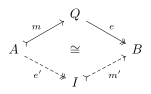
In a 2-category satisfying (DI2), the dinversion of every antinormal pair is normal. In particular, a 2-di-exact 2-category is homologically self-dual.
Let \((m,e)\) be an antinormal pair, with 2-kernel \(2\text{-}\mathrm{ker}(e)\) and 2-cokernel \(2\text{-}\mathrm{coker}(m)\). A 2-kernel is a normal 2-monomorphism and a 2-cokernel is a normal 2-epimorphism, so the dinversion \(w=2\text{-}\mathrm{coker}(m)\circ 2\text{-}\mathrm{ker}(e)\) is a normal 2-monomorphism followed by a normal 2-epimorphism, that is, an antinormal morphism. By (DI2) it is normal. Homological self-duality is the special case in which \(e\circ m\cong 0\).
The argument never uses the hypothesis \(e\circ m\cong 0\), which is why the conclusion is stated for every antinormal pair and not only for an antinormal decomposition of the zero map. It does not use condition (DI1) either, so no 2-kernel or 2-cokernel need exist beyond the two named in the statement; and it does not use that the bizero object is strong.
Any abelian category \(\mathsf{A}\), regarded as a locally discrete 2-category in the sense of Section 2, is 2-di-exact.
Everything discretises. Two parallel null 1-cells are both the zero morphism, hence equal, hence carry exactly one 2-cell between them, so the zero object of \(\mathsf{A}\) is a strong bizero object; in dimension one there is no difference between a bizero object and a strong one. Since the only invertible 2-cells are identities, a 1-cell is essentially null exactly when the morphism it names is zero, 2-kernels are kernels, 2-cokernels are cokernels, 2-monomorphisms are monomorphisms and 2-epimorphisms are epimorphisms. Condition (DI1) is then the statement that every morphism of \(\mathsf{A}\) has a kernel and a cokernel, and condition (DI2) is the image factorisation: in an abelian category every monomorphism is the kernel of its cokernel and every epimorphism is the cokernel of its kernel, so every 1-cell is normal, and a fortiori every antinormal one is.
Example 6.5 is one-dimensional, so it exhibits nothing that the classical theory does not already contain; its purpose is to show that the hypotheses of this section are consistent, and with them that homological self-duality and the Pure Snake Lemma are not vacuous. A genuinely two-dimensional model is the subject of Section 8. The candidate that suggests itself, the 2-category \(\mathit{AbCat}\) of abelian categories, exact functors and natural transformations, satisfies (DI1) but not (DI2) (Proposition 8.12); what works instead is to cut out the abelian categories in which the obstruction vanishes, and the resulting 2-category (Theorem 8.17) contains the finitely generated modules over every commutative Noetherian ring and \(\mathsf{Coh}(X)\) for every noetherian scheme \(X\) (Corollary 8.27). A second model, locally ordered rather than locally discrete, is the 2-category of complete modular lattices of Theorem 8.37, where condition (DI2) is Dedekind’s transposition principle.
The 2-homological 2-categories of [ 6 , Definition 1.6 ] are axiomatised differently, and dinversion says where they sit. The conditions there are that the 2-category have a strong bizero object and all 2-kernels and all 2-cokernels; that its normal 2-monomorphisms and its normal 2-epimorphisms each be closed under composition; and that every antinormal composite \(e\circ m\) for which \(2\text{-}\mathrm{ker}(e)\) factors through \(m\) be normal. The first condition is 2-z-exactness and the second is \(\textup{(NEC)}\) together with its dual. The third is condition (DI2) restricted to those antinormal pairs whose dinversion vanishes: a normal 2-monomorphism \(m\) is a 2-kernel of \(2\text{-}\mathrm{coker}(m)\) by Proposition 3.11, so \(2\text{-}\mathrm{ker}(e)\) factors through \(m\) exactly when the dinversion \(w=2\text{-}\mathrm{coker}(m)\circ 2\text{-}\mathrm{ker}(e)\) is null.
What identifies the restriction is that dinversion interchanges that hypothesis with that conclusion. It carries an antinormal pair \((m,e)\) to \((2\text{-}\mathrm{ker}(e),2\text{-}\mathrm{coker}(m))\), whose antinormal composite is \(w\) and whose own dinversion is \(e\circ m\) again, and it is involutive, so it permutes the antinormal pairs. Read on the dinverse pair, the third condition therefore says that the dinversion of every antinormal decomposition of the zero map is normal, and that is Definition 4.17. A 2-homological 2-category is precisely a homologically self-dual 2-z-exact 2-category satisfying \(\textup{(NEC)}\) and its dual.
This locates the gap between the two settings, and it is a single hypothesis. Such a 2-category satisfies everything Section 4 asks for, so the Pure Snake Lemma holds in it; and it satisfies \(\textup{(NEC)}\), which is the second hypothesis of Theorem 9.19. Only the first is missing, homological self-duality standing where \(\textup{(DPN)}\) is wanted. By Corollary 9.26 that difference is real: the 2-category \(\mathit{AbCat}\) is 2-homological, by Proposition 9.22 and Proposition 9.23, and it fails \(\textup{(DPN)}\) by Proposition 9.25, so neither Theorem 6.9 nor Theorem 9.19 is available there. The 2-category \(\mathit{Sup}\) of Proposition 8.38 is a second example of the same kind, with the pentagon as witness. In the other direction, condition (DI2) does not imply the two closure conditions: Remark 9.6 separates it from \(\textup{(NEC)}\) already in dimension one. So neither package contains the other.
6.8 The statement, and the construction
In a 2-di-exact 2-category, consider a diagram
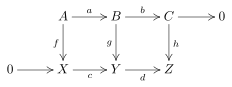
whose two squares commute up to invertible 2-cells \(\varphi \colon g\circ a\cong c\circ f\) and \(\psi \colon h\circ b\cong d\circ g\), and in which \(f\), \(g\) and \(h\) are normal. If the horizontal rows are 2-exact, then there exists a 1-cell \(\partial \) such that the sequence
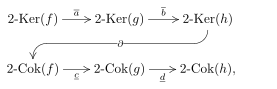
in which \(\overline{a}\) and \(\overline{b}\) are induced by taking 2-kernels and \(\underline{c}\) and \(\underline{d}\) by taking 2-cokernels, is 2-exact.
If, moreover, \(a=2\text{-}\mathrm{ker}(b)\), then \(\overline{a}=2\text{-}\mathrm{ker}(\overline{b})\); dually, if \(d=2\text{-}\mathrm{coker}(c)\), then \(\underline{d}=2\text{-}\mathrm{coker}(\underline{c})\).
No proof environment in the paper (the proof is either immediate or spread over the surrounding text); the dependencies shown are those of the Lean proof.
The pair \((r,\overline{\imath })\) is a normal image factorisation of \(\overline{b}\). In particular \(\overline{b}\) is normal, with \(2\text{-}\mathrm{im}(\overline{b})\simeq \overline{\imath }\), and \(2\text{-}\mathrm{Cok}(\overline{b})\simeq 2\text{-}\mathrm{Cok}(\overline{\imath })\).
Composing with the 2-monomorphism \(2\text{-}\mathrm{ker}(h)\) turns both \(\overline{\imath }\circ r\) and \(\overline{b}\) into \(b\circ 2\text{-}\mathrm{ker}(g)\): for the first by the defining 2-cell of \(\overline{\imath }\) and the factorisation of \(b\circ 2\text{-}\mathrm{ker}(g)\), for the second by the defining 2-cell of \(\overline{b}\). By Remark 2.14 they agree up to an invertible 2-cell. A normal 2-epimorphism followed by a normal 2-monomorphism is a normal image factorisation, by Proposition 3.22, and the last assertion is Proposition 3.9.
6.11 The connecting 1-cell
The 1-cell \(\ell \) is a normal 2-monomorphism, and \(e\) is a normal 2-epimorphism.
The composite \(p\circ a\) is a normal 2-monomorphism followed by a normal 2-epimorphism, hence antinormal, hence normal by (DI2). Now \(p\circ a\cong \ell \circ e\) exhibits it as a 2-epimorphism followed by a 2-monomorphism: \(e\) is a 2-epimorphism, and \(\ell \) is a 2-monomorphism because \(2\text{-}\mathrm{im}(g)\circ \ell \cong c\circ 2\text{-}\mathrm{im}(f)\) is a composite of two 2-monomorphisms, so that part (i) of Proposition 3.6 applies. The second assertion of Proposition 3.22 then makes \(e\) a normal 2-epimorphism and \(\ell \) a normal 2-monomorphism.
Let \(b\) be a 2-cokernel of \(a\), let \(b\circ k\cong i\circ r\) with \(r\) a 2-epimorphism, let \(q\) be a 2-cokernel of \(i\) and let \(p\) be a 2-cokernel of \(k\). If \(e\) is a 2-epimorphism, then \(\pi \) is a 2-cokernel of \(\ell \).
First, \(\pi \circ \ell \circ e\cong \pi \circ p\circ a\cong q\circ b\circ a\cong 0\), and \(e\) is a 2-epimorphism, so \(\pi \circ \ell \cong 0\).
Now let \(w\) satisfy \(w\circ \ell \cong 0\). Then \(w\circ p\circ a\cong w\circ \ell \circ e\cong 0\), so that \(b=2\text{-}\mathrm{coker}(a)\) yields \(v\) with \(v\circ b\cong w\circ p\). Next, \(v\circ i\circ r\cong v\circ b\circ k\cong w\circ p\circ k\cong 0\), because \(p\circ k\) is the composite of a 2-kernel with its 2-cokernel; as \(r\) is a 2-epimorphism, \(v\circ i\cong 0\). Hence \(q=2\text{-}\mathrm{coker}(i)\) yields \(w'\) with \(w'\circ q\cong v\), and then \(w'\circ \pi \circ p\cong w'\circ q\circ b\cong v\circ b\cong w\circ p\), so that \(w'\circ \pi \cong w\) since \(p\) is a 2-epimorphism. Finally \(\pi \) is a 2-epimorphism, because \(\pi \circ p\cong q\circ b\) is one.
Let \(q'\) be a 2-cokernel of \(\overline{b}\), let \(z\) be an equivalence, let \(m\) be a 2-kernel of \(\underline{c}\), and put \(\partial =m\circ z\circ q'\). Then the pair \((\partial ,\underline{c})\) is 2-exact at \(2\text{-}\mathrm{Cok}(f)\); and if \(\overline{b}\) is normal, the pair \((\overline{b},\partial )\) is 2-exact at \(2\text{-}\mathrm{Ker}(h)\).
A 2-cokernel followed by an equivalence is again a 2-cokernel, so \(z\circ q'\) is a normal 2-epimorphism and \(\partial =m\circ (z\circ q')\) already exhibits \(\partial \) as a normal 2-epimorphism followed by \(2\text{-}\mathrm{ker}(\underline{c})\); this is 2-exactness at \(2\text{-}\mathrm{Cok}(f)\), by Proposition 4.4. For the second assertion, take a normal image factorisation \(\overline{b}\cong n\circ e'\). Since \(e'\) is a 2-epimorphism, \(q'\) is a 2-cokernel of \(n\) as well; \(n\) being a normal 2-monomorphism, it is the 2-kernel of that 2-cokernel, by Proposition 3.11; and appending the 2-monomorphism \(m\circ z\) does not change a 2-kernel, by Proposition 3.9. So \(n\) is a 2-kernel of \(\partial \), which is 2-exactness at \(2\text{-}\mathrm{Ker}(h)\).
The 1-cell \(\partial \) depends on the choices made in the construction, but only up to an invertible 2-cell: each of the three comparisons is unique up to an invertible 2-cell over its own data, by Lemma 4.27, and isomorphic equivalences have isomorphic quasi-inverses. Two runs of the construction therefore give connecting 1-cells that agree up to an invertible 2-cell.
6.16 Exactness at the outer positions
Suppose \(a=2\text{-}\mathrm{ker}(b)\) and let \(c\) be a 2-monomorphism. Then \(\overline{a}=2\text{-}\mathrm{ker}(\overline{b})\). Dually, if \(d=2\text{-}\mathrm{coker}(c)\) and \(b\) is a 2-epimorphism, then \(\underline{d}=2\text{-}\mathrm{coker}(\underline{c})\).
From \(b\circ a\cong 0\) and the full faithfulness of \(2\text{-}\mathrm{ker}(h)\) we get \(\overline{b}\circ \overline{a}\cong 0\). Suppose now that \(x\colon T\to 2\text{-}\mathrm{Ker}(g)\) satisfies \(\overline{b}\circ x\cong 0\). Since \(2\text{-}\mathrm{ker}(h)\circ \overline{b}\cong b\circ 2\text{-}\mathrm{ker}(g)\), the composite \(b\circ 2\text{-}\mathrm{ker}(g)\circ x\) is isomorphic to a null morphism, so \(a=2\text{-}\mathrm{ker}(b)\) provides \(y\colon T\to A\) with \(a\circ y\cong 2\text{-}\mathrm{ker}(g)\circ x\). Then
and here the 2-dimensionality is essential: as \(c\) is fully faithful it reflects null morphisms, by Proposition 2.16, so \(f\circ y\cong 0\); hence \(y\cong 2\text{-}\mathrm{ker}(f)\circ y'\) for an essentially unique \(y'\colon T\to 2\text{-}\mathrm{Ker}(f)\). Now
and \(2\text{-}\mathrm{ker}(g)\) being fully faithful forces \(\overline{a}\circ y'\cong x\). Finally \(\overline{a}\) is itself a 2-monomorphism: the composite \(2\text{-}\mathrm{ker}(g)\circ \overline{a}\cong a\circ 2\text{-}\mathrm{ker}(f)\) is one, being a composite of two 2-monomorphisms, and \(2\text{-}\mathrm{ker}(g)\) is one, so part (i) of Proposition 3.6 applies. Hence the factorisation of \(x\) through \(\overline{a}\) is essentially unique, and \(\overline{a}=2\text{-}\mathrm{ker}(\overline{b})\).
This costs far less than the theorem states. It uses neither 2-di-exactness, nor 2-z-exactness, nor the Pure Snake Lemma, nor the normality of \(f\), \(g\) and \(h\). Of the lower row it uses only that \(c\) is a 2-monomorphism: \(c\) need not be a 2-kernel, and \(d\) does not occur in the proof at all. It does use \(a=2\text{-}\mathrm{ker}(b)\), which is the hypothesis of the special case, and it uses that the bizero object is strong—at the reflection step, and nowhere else.
6.19 The general case
The morphism \(f\) restricts along \(e\), that is, there is a 1-cell \(f'\colon 2\text{-}\mathrm{Coim}(a)\to X\) with \(f'\circ e\cong f\); and \(f'\) is normal. Dually \(h\) corestricts along \(2\text{-}\mathrm{im}(d)\) to a normal \(h'\).
Write \(k\) for \(2\text{-}\mathrm{ker}(e)\). Then \(c\circ f\circ k\cong g\circ a\circ k\cong 0\), since \(a\cong a'\circ e\) and \(e\circ k\cong 0\); and \(c\), being fully faithful, reflects this to \(f\circ k\cong 0\), by Proposition 2.16. As \(e\) is a 2-cokernel of \(k\), this produces \(f'\) with \(f'\circ e\cong f\).
For normality, let \(w\) be the 1-cell with \(w\circ e\cong 2\text{-}\mathrm{coim}(f)\), induced in the same way. Then \(w\) is a normal 2-epimorphism, since \(w\circ e\) is one and \(e\) is a 2-epimorphism, by the dual of part (ii) of Proposition 3.6. Cancelling the 2-epimorphism \(e\) in \(f'\circ e\cong f\cong 2\text{-}\mathrm{im}(f)\circ w\circ e\) gives \(f'\cong 2\text{-}\mathrm{im}(f)\circ w\), a normal image factorisation. The dual statement follows by duality.
Let \(e=2\text{-}\mathrm{coim}(a)\), let \(v\colon 2\text{-}\mathrm{Ker}(e)\to 2\text{-}\mathrm{Ker}(f)\) be the comparison induced by \(f\circ 2\text{-}\mathrm{ker}(e)\cong 0\), and let \(f'\) be the restriction of \(f\) along \(e\) of Lemma 6.20. If \(v\) has a 2-cokernel, then the comparison \(\overline{a}''\colon 2\text{-}\mathrm{Ker}(f)\to 2\text{-}\mathrm{Ker}(f')\) is a normal 2-epimorphism. Dually for \(\underline{d}''\).
The two rows
are short 2-exact and share the middle object \(A\); their verticals are \(v\) on the left and, on the right, the 1-cell \(w\) with \(w\circ e\cong 2\text{-}\mathrm{coim}(f)\) of Lemma 6.20. This is a configuration of the shape to which Lemma 4.27 applies, so it supplies an equivalence \(z\colon 2\text{-}\mathrm{Cok}(v)\to 2\text{-}\mathrm{Ker}(w)\) with \(2\text{-}\mathrm{ker}(w)\circ z\circ 2\text{-}\mathrm{coker}(v)\cong e\circ 2\text{-}\mathrm{ker}(f)\). Now \(f'\cong 2\text{-}\mathrm{im}(f)\circ w\) by Lemma 6.20, so \(2\text{-}\mathrm{Ker}(w)\simeq 2\text{-}\mathrm{Ker}(f')\) by Proposition 3.9; and the displayed triangle is exactly the one characterising \(\overline{a}''\). Hence \(\overline{a}''\cong z\circ 2\text{-}\mathrm{coker}(v)\), a 2-cokernel followed by an equivalence, and therefore a normal 2-epimorphism.
The reduction is 2-dimensional in exactly one place, and it is not the place the special case is: Proposition 2.16 is used three times, to produce \(f'\), the comparison on 2-kernels, and—dually—\(h'\). Proposition 6.21 uses no 2-di-exactness beyond what Proposition 6.3 needs to make the Pure Snake Lemma available, no 2-z-exactness, and no identification of a 2-image; its only existence assumption is a 2-cokernel of \(v\).
6.23 The classical Snake Lemma
In a di-exact category, consider a commutative diagram
in which \(f\), \(g\) and \(h\) are normal. If the horizontal rows are exact, then there is a morphism \(\partial \colon \mathrm{Ker}(h)\to \mathrm{Cok}(f)\) making the sequence
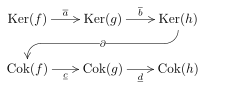
exact. If moreover \(a=\ker (b)\), then \(\overline{a}=\ker (\overline{b})\); dually, if \(d=\mathrm{coker}(c)\), then \(\underline{d}=\mathrm{coker}(\underline{c})\).
No proof environment in the paper (the proof is either immediate or spread over the surrounding text); the dependencies shown are those of the Lean proof.
The corollary rests on the discretisation of Section 2.1, which reads a 1-category as a locally discrete 2-category. That reading is a section of a quotient running the other way: the 1-truncation \(\tau _{1}\mathit{L}\) of a 2-category \(\mathit{L}\) is the 1-category with the same objects in which a morphism \(A\to B\) is an isomorphism class \([f]\) of 1-cells \(f\colon A\to B\), all 2-cells being discarded. When \(\mathit{L}\) has a bizero object, any two null morphisms \(A\to B\) are isomorphic, and their common class makes \(\tau _{1}\mathit{L}\) pointed. It turns out that the truncation preserves and reflects every assertion of Theorem 6.9, so that the theorem—though not the construction that proves it, and not the naturality of Section 7—may alternatively be deduced from its 1-categorical counterpart. This remark records the argument, and where it stops. The 1-truncation is studied in its own right in [ 6 ] —a 2-pointed 2-category with all 2-kernels and 2-cokernels is 2-homological precisely when its 1-truncation is homological [ 6 , Proposition 1.11 ] —and it is there, not here, that the general account of the exactness properties it preserves and reflects belongs; what follows is the special case that the Snake Lemma needs.
The truncation sends 2-kernels to kernels. This is not a general fact about bilimits: a bipullback in the sense of Definition 5.2 yields, in general, only a weak pullback in \(\tau _{1}\mathit{L}\), because condition (1) there produces a factorisation for each choice of filling 2-cell \(\psi \), and factorisations for distinct choices need not be isomorphic. What saves the 2-kernel is its condition (2). Given \([z]\) with \([f]\circ [z]=0\), condition (1) of Definition 2.18 provides a factorisation \([z]=[2\text{-}\mathrm{ker}(f)]\circ [u]\), and the class \([u]\) is unique, because \(2\text{-}\mathrm{ker}(f)\circ (-)\) is fully faithful by Proposition 2.21 and fully faithful functors reflect isomorphisms. Conversely, the truncation reflects kernels wherever a 2-kernel exists: if \([k']\) is a kernel of \([f]\), then \([k']\) and \([2\text{-}\mathrm{ker}(f)]\) differ by an isomorphism of \(\tau _{1}\mathit{L}\); the isomorphisms of \(\tau _{1}\mathit{L}\) are precisely the classes of the equivalences of \(\mathit{L}\); so \(k'\) is, up to an invertible 2-cell, a 2-kernel of \(f\) composed with an equivalence, which Corollary 3.8 makes a 2-kernel of \(f\). Under condition (DI1) this argument and its dual identify each notion of this paper that is a property of 1-cells with its discretisation interpreted in \(\tau _{1}\mathit{L}\): normal 2-monomorphisms and normal 2-epimorphisms, normal and antinormal morphisms, dinversion, short 2-exact sequences and, through condition (i) of Proposition 4.4, exactness of a pair of normal morphisms. Thus \(\tau _{1}\mathit{L}\) is z-exact, and each of the conditions (DI2), (DPN), (NEC) and homological self-duality holds in \(\mathit{L}\) if and only if its discretisation holds in \(\tau _{1}\mathit{L}\); in particular, a 2-category satisfying (DI1) is 2-di-exact precisely when its 1-truncation is di-exact. Here lies the abstract reason why each of these axioms, evaluated in a model, will turn into a condition with no 2-dimensional content left in it: Serre saturation in \(\mathit{AbCat}\) (Proposition 8.11), Dedekind’s transposition principle on complete lattices (Proposition 8.36), Mackey’s symmetry on Hilbert lattices (Proposition 9.31).
The Snake Lemma therefore transports. For 2-di-exact \(\mathit{L}\), the hypotheses of Theorem 6.9 truncate to those of Corollary 6.24 in the di-exact category \(\tau _{1}\mathit{L}\): the invertible 2-cells \(\varphi \) and \(\psi \) become commuting squares, 2-exact rows exact rows, normal verticals normal verticals. There the conclusion holds by the 1-categorical Snake Lemma, [ 19 , Theorem 2.2.2 and Corollary 2.2.4 ] , and it reflects: the objects of the six-term exact sequence are \(2\text{-}\mathrm{Ker}(f)\), …, \(2\text{-}\mathrm{Cok}(h)\), its induced morphisms are the classes of \(\overline{a}\), \(\overline{b}\), \(\underline{c}\) and \(\underline{d}\), all of its morphisms are normal, any representative of the connecting class serves as \(\partial \), and 2-exactness at the four positions of Theorem 6.9 follows by reflecting exactness at each of them. The Pure Snake Lemma corresponds in the same way to [ 19 , Lemma 2.2.1 ] , proved there, as Lemma 4.27 is here, from homological self-duality alone. What the transport does not yield is the 2-cells. Its \(\partial \) is a bare isomorphism class, where the construction of Sections 6.8 and 6.11 produces a specific 1-cell, well defined up to an invertible 2-cell by Remark 6.15; the 2-naturality established in Section 7 is a statement about the 2-cells attached to that specific \(\partial \), of which \(\tau _{1}\mathit{L}\) retains nothing, the functoriality of the truncated sequence being its shadow rather than a substitute. Nor does the truncation reach the hypotheses: reflection is not creation, a kernel in \(\tau _{1}\mathit{L}\) does not produce a 2-kernel in \(\mathit{L}\), so condition (DI1)—in a model, Proposition 8.4 or Proposition 8.33—must be established at the level of the hom-categories, which the truncation does not see.