4 Exact sequences and the Pure Snake Lemma
4.1 The canonical comparison
Let \(f\colon A\to B\) be a morphism in a 2-z-exact 2-category. Writing \(2\text{-}\mathrm{coim}(f)=2\text{-}\mathrm{coker}(2\text{-}\mathrm{ker}(f))\) and \(2\text{-}\mathrm{im}(f)=2\text{-}\mathrm{ker}(2\text{-}\mathrm{coker}(f))\), there is a comparison \(j_f\colon 2\text{-}\mathrm{Coim}(f)\to 2\text{-}\mathrm{Im}(f)\), unique up to a unique invertible 2-cell, with \(2\text{-}\mathrm{im}(f)\circ j_f\circ 2\text{-}\mathrm{coim}(f)\cong f\). The morphism \(f\) is normal if and only if \(j_f\) is an equivalence.
Existence and uniqueness of \(j_f\) are the universal properties of \(2\text{-}\mathrm{coim}(f)\) and \(2\text{-}\mathrm{im}(f)\): the composite \(2\text{-}\mathrm{coker}(f)\circ f\) is isomorphic to a null morphism, so \(f\) factors through \(2\text{-}\mathrm{im}(f)=2\text{-}\mathrm{ker}(2\text{-}\mathrm{coker}(f))\), and dually the resulting morphism factors through \(2\text{-}\mathrm{coim}(f)\). Uniqueness holds because \(2\text{-}\mathrm{coim}(f)\) is a 2-epimorphism and \(2\text{-}\mathrm{im}(f)\) a 2-monomorphism, so any two 1-cells filling the triangle agree, by Remark 2.14 and its dual.
If \(j_f\) is an equivalence, then \(f\cong 2\text{-}\mathrm{im}(f)\circ \bigl(j_f\circ 2\text{-}\mathrm{coim}(f)\bigr)\) exhibits \(f\) as a normal 2-monomorphism after a normal 2-epimorphism, the second factor because a 2-cokernel composed with an equivalence is again a 2-cokernel; so \(f\) is normal. Conversely, let \(f\cong m\circ e\) with \(m\) a normal 2-monomorphism and \(e\) a normal 2-epimorphism. By Proposition 3.9 we have \(2\text{-}\mathrm{ker}(f)\simeq 2\text{-}\mathrm{ker}(e)\), and \(e\) is the 2-cokernel of its 2-kernel by Proposition 3.11, so \(2\text{-}\mathrm{coim}(f)\simeq e\); dually \(2\text{-}\mathrm{im}(f)\simeq m\). Under these equivalences the defining relation reads \(m\circ j_f\circ e\cong m\circ e\), and as \(m\) is fully faithful and \(e\) cofully faithful, \(j_f\) is isomorphic to an identity, hence an equivalence.
4.3 Exactness
For a pair \((f,g)\) of composable normal morphisms
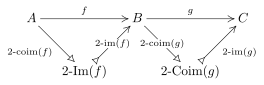
with their respective normal image factorisations, the following conditions are equivalent:
\(2\text{-}\mathrm{im}(f)\simeq 2\text{-}\mathrm{ker}(g)\);
\(2\text{-}\mathrm{coker}(f)\simeq 2\text{-}\mathrm{coim}(g)\);
the pair \((2\text{-}\mathrm{im}(f),2\text{-}\mathrm{coim}(g))\) is a short 2-exact sequence.
By Proposition 3.9, since \(2\text{-}\mathrm{im}(g)\) is a normal 2-monomorphism, \(2\text{-}\mathrm{ker}(g)\simeq 2\text{-}\mathrm{ker}(2\text{-}\mathrm{coim}(g))\); dually, since \(2\text{-}\mathrm{coim}(f)\) is a normal 2-epimorphism, \(2\text{-}\mathrm{coker}(f)\simeq 2\text{-}\mathrm{coker}(2\text{-}\mathrm{im}(f))\). Now \(2\text{-}\mathrm{im}(f)\simeq 2\text{-}\mathrm{ker}(g)\) as in (i) if and only if (iii) holds, because \(2\text{-}\mathrm{coim}(g)\), being a normal 2-epimorphism, is the 2-cokernel of its 2-kernel by Proposition 3.11; likewise \(2\text{-}\mathrm{coker}(f)\simeq 2\text{-}\mathrm{coim}(g)\) as in (ii) if and only if (iii) holds, because \(2\text{-}\mathrm{im}(f)\), being a normal 2-monomorphism, is the 2-kernel of its 2-cokernel.
A pair \((f,g)\) of composable normal morphisms is exact in \(B\) when the equivalent conditions of Proposition 4.4 hold. A sequence of morphisms
is exact if it is exact in each position where the condition makes sense. In particular, every morphism occurring in an exact sequence is required to be normal.
4.6 Dinversion
An antinormal pair \((m,e)\) consists of a normal 2-monomorphism \(m\colon K\to X\) and a normal 2-epimorphism \(e\colon X\to R\); its antinormal composite is \(e\circ m\). The dinverse of \((m,e)\) is the antinormal pair \((2\text{-}\mathrm{ker}(e),2\text{-}\mathrm{coker}(m))\), and the dinversion of \((m,e)\) is the antinormal composite of its dinverse, namely
the diagonal of the cross
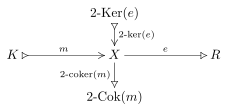
Since \(m\) is the 2-kernel of its 2-cokernel and \(e\) the 2-cokernel of its 2-kernel, by Proposition 3.11, dinversion is involutive: the dinverse of \((2\text{-}\mathrm{ker}(e),2\text{-}\mathrm{coker}(m))\) is again \((m,e)\), up to equivalence.
An antinormal decomposition of the zero map is an antinormal pair \((m,e)\) with \(e\circ m\cong 0\).
Let \((m,e)\) be an antinormal decomposition of the zero map, let \(k\) be a 2-kernel of \(e\) and \(q\) a 2-cokernel of \(m\), and let \(w=q\circ k\) be its dinversion. Then \((m,e)\) is a short 2-exact sequence if and only if \(w\cong 0\).
Suppose \(m=2\text{-}\mathrm{ker}(e)\). From \(e\circ k\cong 0\) the morphism \(k\) factors through \(m\), say \(k\cong m\circ u\), and then \(w\cong q\circ m\circ u\cong 0\) because \(q\circ m\cong 0\). Conversely suppose \(w\cong 0\), and let \(t\) satisfy \(e\circ t\cong 0\). Then \(t\) factors through \(k\), say \(t\cong k\circ u\), so that \(q\circ t\cong w\circ u\cong 0\); and \(m\), being a normal 2-monomorphism, is a 2-kernel of its own 2-cokernel \(q\) by Proposition 3.11, so \(t\) factors through \(m\). Together with \(e\circ m\cong 0\) and the fact that \(m\) is a 2-monomorphism, this exhibits \(m\) as a 2-kernel of \(e\). That \(e\) is then a 2-cokernel of \(m\) is the same argument read in the dual.
Let \((f,g)\) be a pair of composable normal morphisms with \(g\circ f\cong 0\). Then \((f,g)\) is exact in \(B\) if and only if the dinversion
of the antinormal decomposition \((2\text{-}\mathrm{im}(f),2\text{-}\mathrm{coim}(g))\) is null.
No proof environment in the paper (the proof is either immediate or spread over the surrounding text); the dependencies shown are those of the Lean proof.
Let \((m,e)\) be an antinormal pair in a 2-z-exact 2-category, with dinversion \(w=2\text{-}\mathrm{coker}(m)\circ 2\text{-}\mathrm{ker}(e)\). Then \(2\text{-}\mathrm{Cok}(e\circ m)\simeq 2\text{-}\mathrm{Cok}(w)\), and dually \(2\text{-}\mathrm{Ker}(e\circ m)\simeq 2\text{-}\mathrm{Ker}(w)\).
Write \(m\colon K\to X\), \(e\colon X\to R\), \(k=2\text{-}\mathrm{ker}(e)\) and \(q=2\text{-}\mathrm{coker}(m)\), so that \(w=q\circ k\). Being a normal 2-epimorphism, \(e\) is a 2-cokernel of \(k\), by Proposition 3.11.
Let \(u\colon R\to T\) satisfy \(u\circ e\circ m\cong 0\). Then \(q=2\text{-}\mathrm{coker}(m)\) yields \(u'\colon C\to T\) with \(u'\circ q\cong u\circ e\), and \(u'\circ w\cong u\circ e\circ k\cong 0\). Conversely, let \(v\colon C\to T\) satisfy \(v\circ w\cong 0\). Then \(v\circ q\circ k\cong 0\) and \(e=2\text{-}\mathrm{coker}(k)\) yields \(v'\colon R\to T\) with \(v'\circ e\cong v\circ q\), and \(v'\circ e\circ m\cong v\circ q\circ m\cong 0\). Each construction undoes the other, since \(e\) and \(q\) are 2-epimorphisms.
Now let \(q_1\colon R\to Q_1\) be a 2-cokernel of \(e\circ m\) and \(q_2\colon C\to Q_2\) one of \(w\). Applying the first construction to \(q_1\) and the second to \(q_2\) gives \(q_1'\colon C\to Q_1\) with \(q_1'\circ q\cong q_1\circ e\) and \(q_1'\circ w\cong 0\), and \(q_2'\colon R\to Q_2\) with \(q_2'\circ e\cong q_2\circ q\) and \(q_2'\circ e\circ m\cong 0\); whence \(x\colon Q_2\to Q_1\) with \(x\circ q_2\cong q_1'\) and \(y\colon Q_1\to Q_2\) with \(y\circ q_1\cong q_2'\). Then \(x\circ q_2'\circ e\cong x\circ q_2\circ q\cong q_1'\circ q\cong q_1\circ e\), so \(x\circ q_2'\cong q_1\) as \(e\) is a 2-epimorphism; hence \(x\circ y\circ q_1\cong q_1\) and \(x\circ y\cong \operatorname {id}_{Q_1}\), \(q_1\) being a 2-epimorphism. Symmetrically \(y\circ x\cong \operatorname {id}_{Q_2}\). So \(x\) is an equivalence.
The proof uses of \((m,e)\) only that \(q\) is a 2-cokernel of \(m\) and that \(e\) is a 2-cokernel of \(2\text{-}\mathrm{ker}(e)\); nothing is asked of the composite \(e\circ m\), which need be neither null nor normal. In the abelian case the lemma reads \(R/e(K)\cong X/(K+N)\cong C/q(N)\) for \(N=\mathrm{Ker}(e)\), which is the identification the classical Snake Lemma makes when it computes the two ends of the connecting morphism.
4.12 Normal chain complexes and homology
In a 2-z-exact 2-category, every null morphism is normal.
Let \(0\colon A\to B\) be null. Since \(\operatorname {id}_{A}\) is a 2-kernel of it, \(2\text{-}\mathrm{Coim}(0)=2\text{-}\mathrm{Cok}(\operatorname {id}_{A})\), which is trivial because a 2-epimorphism has trivial 2-cokernel, by the dual of Lemma 2.24; dually \(2\text{-}\mathrm{Im}(0)=2\text{-}\mathrm{Ker}(\operatorname {id}_{B})\) is trivial. Now any morphism \(t\colon P\to I\) between trivial objects is an equivalence: taking \(s\colon I\to P\) to be a null morphism, both \(t\circ s\) and \(\operatorname {id}_{I}\) are null, hence isomorphic by Lemma 2.6, and dually for \(s\circ t\). The composite \(2\text{-}\mathrm{ker}(\operatorname {id}_{B})\circ t\circ 2\text{-}\mathrm{coker}(\operatorname {id}_{A})\) is therefore a normal 2-monomorphism after a normal 2-epimorphism—a 2-cokernel composed with an equivalence being again a 2-cokernel—and it is null, hence isomorphic to \(0\).
A normal chain complex \((C,d)\) is a sequence of normal morphisms \(d_n\colon C_n\to C_{n-1}\), for \(n\in \mathbb {Z}\), with \(d_n\circ d_{n+1}\cong 0\). This relation makes \(2\text{-}\mathrm{im}(d_{n+1})\) factor through \(2\text{-}\mathrm{ker}(d_n)\) and, dually, \(2\text{-}\mathrm{coim}(d_n)\) factor through \(2\text{-}\mathrm{coker}(d_{n+1})\). The cokernel homology and kernel homology of \((C,d)\) at position \(n\) are
and
Equivalently, \(\mathrm{H}^{\mathrm{coker}}_{n}(C)=2\text{-}\mathrm{Coim}(w_n)\) and \(\mathrm{H}^{\ker }_{n}(C)=2\text{-}\mathrm{Im}(w_n)\), where
is the dinversion of the antinormal pair \((2\text{-}\mathrm{im}(d_{n+1}),2\text{-}\mathrm{coim}(d_n))\); we write
for the comparison of Lemma 4.2.
A normal chain complex is indexed by \(\mathbb {Z}\), so a finite sequence of normal morphisms has to be padded with bizero objects and null morphisms before it becomes one. Proposition 4.13 is what makes this legitimate, and it is the only place in this section where 2-z-exactness does anything beyond making a statement expressible.
4.16 Homological self-duality
A 2-z-exact 2-category is homologically self-dual when the dinversion of every antinormal decomposition of the zero map is a normal morphism.
For a 2-z-exact 2-category the following conditions are equivalent.
The 2-category is homologically self-dual; that is, the dinversion of every antinormal decomposition of the zero map is normal.
Homology is self-dual: for every normal chain complex \((C,d)\) and every \(n\), the comparison \(j_n\colon \mathrm{H}^{\mathrm{coker}}_{n}(C)\to \mathrm{H}^{\ker }_{n}(C)\) is an equivalence.
The Pure Snake condition holds: in every morphism of short 2-exact sequences with identity middle component, as in Lemma 4.27 below, the comparison \(2\text{-}\mathrm{Cok}(f)\to 2\text{-}\mathrm{Ker}(h)\) is an equivalence.
By Lemma 4.2 a morphism is normal exactly when its comparison is an equivalence. We show that each of the three conditions asserts precisely this for the dinversion of an arbitrary antinormal decomposition of the zero map. Condition (i) is that assertion verbatim.
For (ii), a normal chain complex and a position \(n\) provide the antinormal decomposition \((2\text{-}\mathrm{im}(d_{n+1}),2\text{-}\mathrm{coim}(d_n))\) of the zero map, whose antinormal composite is null since \(d_n\circ d_{n+1}\cong 0\); its dinversion is \(w_n\), with comparison \(j_n\). Conversely an antinormal decomposition \((m,e)\) of the zero map, with \(m\colon K\to X\) and \(e\colon X\to R\), sits at position \(0\) of the normal chain complex with \(K\), \(X\) and \(R\) in degrees \(2\), \(1\) and \(0\), a bizero object in every other degree, \(m\) and \(e\) as the two remaining differentials and null morphisms elsewhere; the padding is normal by Proposition 4.13, and the dinversion at position \(0\) is \(w\). Hence (i) and (ii) coincide.
For (iii), take a morphism of short 2-exact sequences with identity middle component, with top row \(A\xrightarrow []{a}B\xrightarrow []{b}C\), bottom row \(X\xrightarrow []{c}B\xrightarrow []{d}Z\) and verticals \(f\), \(\operatorname {id}_{B}\), \(h\). Then \((a,d)\) is an antinormal decomposition of the zero map, since \(d\circ a\cong d\circ c\circ f\cong 0\), with dinversion \(w=2\text{-}\mathrm{coker}(a)\circ 2\text{-}\mathrm{ker}(d)\cong b\circ c\). We claim \(2\text{-}\mathrm{ker}(w)\simeq f\). Indeed \(w\circ f\cong b\circ a\cong 0\), so \(f\) factors through \(2\text{-}\mathrm{ker}(w)\); and if \(t\) carries an invertible 2-cell \(w\circ t\cong 0\), then \(b\circ (c\circ t)\cong 0\), so the universal property of \(a=2\text{-}\mathrm{ker}(b)\) gives \(s\) with \(a\circ s\cong c\circ t\), whence \(c\circ f\circ s\cong c\circ t\) and, \(c\) being fully faithful, \(f\circ s\cong t\) essentially uniquely. Dually \(2\text{-}\mathrm{coker}(w)\simeq h\). Thus \(2\text{-}\mathrm{Coim}(w)\simeq 2\text{-}\mathrm{Cok}(f)\) and \(2\text{-}\mathrm{Im}(w)\simeq 2\text{-}\mathrm{Ker}(h)\), with \(j_w\) the comparison \(2\text{-}\mathrm{Cok}(f)\to 2\text{-}\mathrm{Ker}(h)\).
Conversely, let \((m,e)\) be an antinormal decomposition of the zero map. Take the top row \(K\xrightarrow []{m}X\xrightarrow []{2\text{-}\mathrm{coker}(m)}2\text{-}\mathrm{Cok}(m)\) and the bottom row \(2\text{-}\mathrm{Ker}(e)\xrightarrow []{2\text{-}\mathrm{ker}(e)}X\xrightarrow []{e}R\), both short 2-exact by Proposition 3.11, and the identity of \(X\) as middle component. The invertible 2-cell \(e\circ m\cong 0\) factors \(m\) through \(2\text{-}\mathrm{ker}(e)\) by some \(t\colon K\to 2\text{-}\mathrm{Ker}(e)\) and factors \(e\) through \(2\text{-}\mathrm{coker}(m)\) by some \(r\colon 2\text{-}\mathrm{Cok}(m)\to R\); these are the two outer verticals, and no coherence condition need be checked, by Proposition 3.26. The dinversion of the resulting configuration is \(2\text{-}\mathrm{coker}(m)\circ 2\text{-}\mathrm{ker}(e)\), which is \(w\) itself. Hence (i) and (iii) coincide.
The two directions of each equivalence are not paid for alike. The implications out of homological self-duality use no 2-z-exactness at all: every 2-kernel and 2-cokernel they need is either named in the target condition or produced by the normal image factorisation that self-duality itself supplies. The converses do use it—(iii) \(\Rightarrow \) (i) has to form the 2-cokernel of \(t\) and the 2-kernel of \(r\) before condition (iii) can be applied, and (ii) \(\Rightarrow \) (i) needs it twice, once to pad the complex and once to form the comparison.
4.20 The Third Isomorphism Property
A sequence of 2-monomorphisms \(A\xrightarrow []{a}X\xrightarrow []{c}B\) is totally normal when \(a\), \(c\) and the composite \(c\circ a\) are all normal 2-monomorphisms. Dually, a sequence of 2-epimorphisms \(X\xrightarrow []{p}Y\xrightarrow []{q}Z\) is totally normal when \(p\), \(q\) and \(q\circ p\) are all normal 2-epimorphisms.
For a 2-z-exact 2-category the following conditions are equivalent.
The 2-category is homologically self-dual.
For every totally normal sequence of 2-monomorphisms \(A\xrightarrow []{a}X\xrightarrow []{c}B\), the induced sequence
\[ 2\text{-}\mathrm{Cok}(a)\longrightarrow 2\text{-}\mathrm{Cok}(c\circ a)\longrightarrow 2\text{-}\mathrm{Cok}(c) \]is short 2-exact.
For every totally normal sequence of 2-epimorphisms \(X\xrightarrow []{p}Y\xrightarrow []{q}Z\), the induced sequence
\[ 2\text{-}\mathrm{Ker}(p)\longrightarrow 2\text{-}\mathrm{Ker}(q\circ p)\longrightarrow 2\text{-}\mathrm{Ker}(q) \]is short 2-exact.
Conditions (ii) and (iii) are dual, so we prove that (i) and (ii) are equivalent, using the Pure Snake characterisation Proposition 4.18 (iii).
Given a totally normal sequence of 2-monomorphisms \(A\xrightarrow []{a}X\xrightarrow []{c}B\), put \(b=c\circ a\) and form the morphism of short 2-exact sequences with identity middle component whose top row is \(A\xrightarrow []{b}B\xrightarrow []{2\text{-}\mathrm{coker}(b)}2\text{-}\mathrm{Cok}(b)\), bottom row \(X\xrightarrow []{c}B\xrightarrow []{2\text{-}\mathrm{coker}(c)}2\text{-}\mathrm{Cok}(c)\), and right vertical \(r\) induced by \(2\text{-}\mathrm{coker}(c)\circ b\cong 0\). Both rows are short 2-exact by Proposition 3.11, as \(b\) and \(c\) are normal 2-monomorphisms, and no coherence condition arises, by Proposition 3.26. As in the proof of Proposition 4.18, the dinversion is \(w=2\text{-}\mathrm{coker}(b)\circ c\), with \(2\text{-}\mathrm{ker}(w)\simeq a\) and \(2\text{-}\mathrm{coker}(w)\simeq r\); hence the induced 1-cell \(2\text{-}\mathrm{Cok}(a)\simeq 2\text{-}\mathrm{Coim}(w)\to 2\text{-}\mathrm{Cok}(b)\) is \(2\text{-}\mathrm{im}(w)\circ j_w\), with 2-cokernel \(r\). The sequence \(2\text{-}\mathrm{Cok}(a)\to 2\text{-}\mathrm{Cok}(b)\to 2\text{-}\mathrm{Cok}(c)\) is therefore short 2-exact if and only if \(j_w\) is an equivalence, that is, if and only if \(w\) is normal; and by Proposition 4.18 this holds for all such \(w\) precisely when the 2-category is homologically self-dual.
Conversely, let \((m,e)\) be an antinormal decomposition of the zero map, with dinversion \(w=2\text{-}\mathrm{coker}(m)\circ 2\text{-}\mathrm{ker}(e)\). The invertible 2-cell \(e\circ m\cong 0\) corestricts \(m\) to a morphism \(t\colon K\to 2\text{-}\mathrm{Ker}(e)\) with \(m\cong 2\text{-}\mathrm{ker}(e)\circ t\), and \(t\) is a normal 2-monomorphism by part (ii) of Proposition 3.6, the 2-monomorphism \(2\text{-}\mathrm{ker}(e)\) cancelling off the normal 2-monomorphism \(m\). So \(K\xrightarrow []{t}2\text{-}\mathrm{Ker}(e)\xrightarrow []{2\text{-}\mathrm{ker}(e)}X\) is a totally normal sequence of 2-monomorphisms. Applying (ii) to it returns a short 2-exact sequence whose 2-monomorphism part is the induced 1-cell \(2\text{-}\mathrm{Cok}(t)\to 2\text{-}\mathrm{Cok}(m)\); composed with \(2\text{-}\mathrm{coker}(t)\), that 1-cell is \(w\), by the construction of the induced morphism. Hence \(w\) is a normal 2-monomorphism after a normal 2-epimorphism, so normal.
4.23 Exactness via homology
In a homologically self-dual 2-category, let \((f,g)\) be a pair of composable normal morphisms with \(g\circ f\cong 0\). Taking the 2-kernel of \(g\) and the 2-cokernel of \(f\), we obtain induced morphisms \(e\) and \(m\) and the 2-image \(H\) of the composite \(2\text{-}\mathrm{coker}(f)\circ 2\text{-}\mathrm{ker}(g)\).
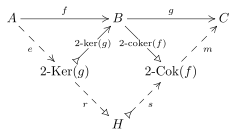
The following conditions are equivalent:
\(e\) is a 2-epimorphism;
\(m\) is a 2-monomorphism;
\((f,g)\) is exact in \(B\);
\(H\) is trivial.
Write \(p=2\text{-}\mathrm{coker}(f)\circ 2\text{-}\mathrm{ker}(g)\); then \(H\) is its 2-image, with \(r=2\text{-}\mathrm{coim}(p)\) and \(s=2\text{-}\mathrm{im}(p)\). For a morphism \(x\) into \(2\text{-}\mathrm{Ker}(g)\), an invertible 2-cell \(p\circ x\cong 0\) amounts to \(2\text{-}\mathrm{ker}(g)\circ x\) factoring through \(2\text{-}\mathrm{im}(f)=2\text{-}\mathrm{ker}(2\text{-}\mathrm{coker}(f))\); since \(2\text{-}\mathrm{im}(f)\simeq 2\text{-}\mathrm{ker}(g)\circ 2\text{-}\mathrm{im}(e)\) and \(2\text{-}\mathrm{ker}(g)\) is fully faithful, this amounts to \(x\) factoring through \(2\text{-}\mathrm{im}(e)\). Hence \(2\text{-}\mathrm{ker}(p)\simeq 2\text{-}\mathrm{im}(e)\) and \(H=2\text{-}\mathrm{Coim}(p)\simeq 2\text{-}\mathrm{Cok}(e)\); dually \(H=2\text{-}\mathrm{Im}(p)\simeq 2\text{-}\mathrm{Ker}(m)\).
The pair \((f,g)\) is exact in \(B\) precisely when \(2\text{-}\mathrm{im}(f)\simeq 2\text{-}\mathrm{ker}(g)\), that is, when \(2\text{-}\mathrm{im}(e)\simeq 2\text{-}\mathrm{Ker}(g)\), that is, when \(2\text{-}\mathrm{Coim}(p)=H\) is trivial; this is (iii)\(\Leftrightarrow \)(iv). If \((f,g)\) is exact, then \(2\text{-}\mathrm{ker}(g)\circ e\cong f\cong 2\text{-}\mathrm{im}(f)\circ 2\text{-}\mathrm{coim}(f)\) with \(2\text{-}\mathrm{im}(f)\simeq 2\text{-}\mathrm{ker}(g)\), so \(e\simeq 2\text{-}\mathrm{coim}(f)\) is a normal 2-epimorphism and dually \(m\simeq 2\text{-}\mathrm{im}(g)\) is a normal 2-monomorphism; thus (iii) implies (i) and (ii). Conversely, a 2-epimorphism has trivial 2-cokernel and a 2-monomorphism has trivial 2-kernel by Lemma 2.24, so \(e\) a 2-epimorphism gives \(H\simeq 2\text{-}\mathrm{Cok}(e)\) trivial and \(m\) a 2-monomorphism gives \(H\simeq 2\text{-}\mathrm{Ker}(m)\) trivial; thus (i) and (ii) each imply (iv).
Homological self-duality is used for one thing only: to know that \(p\) is normal, so that its 2-image and its 2-coimage agree and the object \(H\) exists at all. Once \(H\) is given, together with the factorisation of \(p\) as \(2\text{-}\mathrm{im}(p)\circ 2\text{-}\mathrm{coim}(p)\), the equivalence of the four conditions holds in any 2-category with a strong bizero object. This matters in Section 6, where the criterion is applied repeatedly.
4.26 The Pure Snake Lemma
In a homologically self-dual 2-category, a morphism of short 2-exact sequences with identity middle component
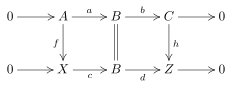
induces the 2-exact sequence

In particular \(f\) is a normal 2-monomorphism and \(h\) is a normal 2-epimorphism, and the comparison
is an equivalence, unique up to a unique invertible 2-cell with that property.
The proof of Proposition 4.18 identifies \(f\) with \(2\text{-}\mathrm{ker}(w)\) and \(h\) with \(2\text{-}\mathrm{coker}(w)\) for the dinversion \(w\cong b\circ c\), so that \(2\text{-}\mathrm{Coim}(w)\simeq 2\text{-}\mathrm{Cok}(f)\) and \(2\text{-}\mathrm{Im}(w)\simeq 2\text{-}\mathrm{Ker}(h)\) and the comparison \(j_w\) of Lemma 4.2 is the displayed \(j\). Its uniqueness is that of Lemma 4.2: \(2\text{-}\mathrm{coker}(f)\) is a 2-epimorphism and \(2\text{-}\mathrm{ker}(h)\) a 2-monomorphism, so any two 1-cells filling the triangle agree. Homological self-duality makes \(w\) normal, hence \(j\) an equivalence by Lemma 4.2, which is 2-exactness at \(X\) and at \(C\); exactness at \(A\) and at \(Z\) says that \(f\) is a 2-monomorphism and \(h\) a 2-epimorphism, which they are, being a 2-kernel and a 2-cokernel of \(w\).
The identifications \(f\simeq 2\text{-}\mathrm{ker}(w)\) and \(h\simeq 2\text{-}\mathrm{coker}(w)\) use neither homological self-duality nor the strongness of the bizero object: they are factorisation arguments through the universal properties of the two rows. Self-duality enters at exactly one point, 2-exactness at \(C\), which is where the normality of \(w\) is required.