5 Bipullbacks and the squares of a morphism of short 2-exact sequences
5.1 Bipullbacks
Let \(A\xrightarrow []{f}C\) and \(B\xrightarrow []{g}C\) be morphisms in a 2-category \(\mathit{L}\). A bipullback of \(f\) and \(g\) is an object \(P\) together with morphisms \(P\xrightarrow []{p_1}A\) and \(P\xrightarrow []{p_2}B\) and an isomorphism 2-cell  such that:
for all morphisms \(Z\xrightarrow []{a}A\) and \(Z\xrightarrow []{b}B\) and every isomorphism 2-cell

there exist a morphism \(Z\xrightarrow []{u}P\) and isomorphism 2-cells
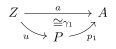 and
and 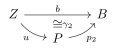
such that \(\psi \) is equal to the pasting
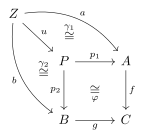
for all morphisms \(u\), \(v\colon Z\to P\) and all 2-cells
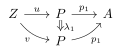 and
and 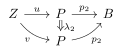
satisfying \((g\star \lambda _2)\cdot (\varphi \star u)=(\varphi \star v)\cdot (f\star \lambda _1)\), there exists a unique 2-cell \(\mu \colon u\Rightarrow v\) such that \(p_1\star \mu =\lambda _1\) and \(p_2\star \mu =\lambda _2\).
The dual notion is that of a bipushout.
Let \(\mathit{L}\) be a 2-category with a strong bizero object and let \(f\colon A\to B\) be a morphism. A morphism \(k\colon K\to A\) is a 2-kernel of \(f\) if and only if it is, together with the essentially unique morphism \(K\to 0\), a bipullback of \(f\) along a chosen null morphism \(0\to B\). Dually for 2-cokernels and bipushouts.
A square over the cospan formed by \(A\xrightarrow []{f}B\) and a chosen null morphism \(0\to B\), with vertex \(Z\), consists of a morphism \(a\colon Z\to A\), a morphism \(Z\to 0\)—of which there is one up to a unique isomorphism—and an invertible 2-cell \(\psi \) whose codomain is a null morphism; so it amounts to a morphism \(a\) together with an invertible 2-cell \(f\circ a\cong 0\), which is exactly the datum to which condition (1) of Definition 2.18 applies. The second factorisation 2-cell \(\gamma _2\) and the pasting condition carry no information, by Lemma 2.6: any two 2-cells into a morphism isomorphic to a null one agree. Likewise a pair of 2-cells \((\lambda _1,\lambda _2)\) as in condition (2) of Definition 5.2 reduces to \(\lambda _1\), and the required equation holds automatically for the same reason. Conditions (1) and (2) of Definition 5.2 therefore say precisely what conditions (1) and (2) of Definition 2.18 say.
Normal 2-monomorphisms are stable under bipullback. Precisely, let
be a bipullback in a 2-category with a strong bizero object, let \(g\) be a 2-kernel of \(w\colon C\to W\), and suppose that \(p_1\) is a 2-monomorphism. Then \(p_1\) is a 2-kernel of \(w\circ f\); in particular it is a normal 2-monomorphism.
First, \(w\circ f\circ p_1\cong w\circ g\circ p_2\cong 0\), using \(\varphi \) and the structure 2-cell of the 2-kernel \(g\). For the universal property, let \(z\colon Z\to A\) satisfy \(w\circ f\circ z\cong 0\). Since \(g\) is a 2-kernel of \(w\), there are \(y\colon Z\to B\) and an invertible 2-cell \(g\circ y\cong f\circ z\); this is a square over the cospan formed by \(f\) and \(g\), so condition \((1)\) of Definition 5.2 provides \(u\colon Z\to P\) with \(p_1\circ u\cong z\). The 2-dimensional condition of Definition 2.18 is the hypothesis that \(p_1\) be a 2-monomorphism. Hence \(p_1\) is a 2-kernel of \(w\circ f\).
The hypothesis that \(p_1\) be a 2-monomorphism is what one would obtain from the stability of 2-monomorphisms under bipullback; we have not needed that stability in general, and in the one application below (Proposition 9.11) the hypothesis is verified directly. Note also that no bilimit is constructed in the proof: as in Remark 5.8, the bipullback is the one given.
5.6 The two squares
If the morphism \(h\) is a 2-monomorphism, then the square on the left is a bipullback.
We verify the universal property of Definition 5.2 directly for the square with vertex \(K'\), projections \(f\colon K'\to K\) and \(k'\colon K'\to A'\) and structure 2-cell \(\varphi _K\colon g\circ k'\cong k\circ f\).
For condition (1), let \(a\colon Z\to K\) and \(b\colon Z\to A'\) come with an invertible 2-cell \(\psi \colon g\circ b\cong k\circ a\). Postcomposing with \(q\) and using the structure 2-cell \(\kappa \colon q\circ k\cong 0\) of the lower row gives \(q\circ g\circ b\cong 0\), and \(\varphi _Q\colon h\circ q'\cong q\circ g\) turns this into \(h\circ q'\circ b\cong 0\). As \(h\) is a 2-monomorphism it reflects null morphisms, by Proposition 2.16, so \(q'\circ b\cong 0\); since \(k'=2\text{-}\mathrm{ker}(q')\), the morphism \(b\) factors as \(b\cong k'\circ u\) for some \(u\colon Z\to K'\), and this is the invertible 2-cell \(\gamma _2\). For \(\gamma _1\), note that
so that \(f\circ u\cong a\) because \(k\) is a 2-monomorphism, by Remark 2.14. The pasting condition is then an equation between two invertible 2-cells with codomain \(k\circ a\); it holds because \(k\) is a 2-monomorphism, whiskering with \(k\) being injective on 2-cells.
For condition (2), let \(u\), \(v\colon Z\to K'\) and let \(\lambda _1\colon f\circ u\Longrightarrow f\circ v\) and \(\lambda _2\colon k'\circ u\Longrightarrow k'\circ v\) satisfy the compatibility of Definition 5.2. Since \(k'\) is a 2-kernel, hence a 2-monomorphism, there is a unique 2-cell \(\mu \colon u\Longrightarrow v\) with \(k'\star \mu =\lambda _2\); and \(f\star \mu =\lambda _1\) follows, because whiskering both sides with the 2-monomorphism \(k\) gives equal 2-cells, by the compatibility just assumed.
The proof forms no bipullback other than the one it asserts, so it needs no bilimit hypothesis beyond the statement. It also uses less than the statement offers: only that \(k'\) is a 2-kernel of \(q'\), that \(k\) is a 2-kernel of \(q\), and that \(h\) is a 2-monomorphism. That \(q'\) is a 2-cokernel of \(k'\), and that \(q\) is a 2-cokernel of \(k\), never enter.
If the square on the right is a bipullback, then the morphism \(f\) is an equivalence.
The right-hand square exhibits \(A'\) as the bipullback of \(q\) along \(h\), with projections \(g\colon A'\to A\) and \(q'\colon A'\to Q'\) and structure 2-cell \(\varphi _Q\). Composing the structure 2-cell \(\kappa \colon q\circ k\cong 0\) of the lower row with the null isomorphism \(h\circ 0\cong 0\) yields an invertible 2-cell \(q\circ k\cong h\circ 0\), to which the universal property of the bipullback associates a morphism \(s\colon K\to A'\) together with invertible 2-cells \(g\circ s\cong k\) and \(q'\circ s\cong 0\). From the latter and \(k'=2\text{-}\mathrm{ker}(q')\) we obtain \(t\colon K\to K'\) with an invertible 2-cell \(k'\circ t\cong s\). We claim that \(t\) is a quasi-inverse of \(f\).
First, \(k\circ f\circ t\cong g\circ k'\circ t\cong g\circ s\cong k\), using \(\varphi _K\); since \(k\) is fully faithful, this reflects to an invertible 2-cell \(f\circ t\cong \operatorname {id}_{K}\). Next, the morphisms \(s\circ f\) and \(k'\) from \(K'\) to \(A'\) satisfy \(g\circ s\circ f\cong k\circ f\cong g\circ k'\), through \(\varphi _K\), and \(q'\circ s\circ f\cong 0\cong q'\circ k'\), through \(\kappa '\). These two invertible 2-cells are compatible with the structure 2-cell \(\varphi _Q\) of the bipullback: the compatibility required is an equation between two invertible 2-cells with the same domain and with codomain \(q\circ g\circ k'\), which is isomorphic to a null morphism, so Lemma 2.6 supplies it. The uniqueness clause of the bipullback then yields an invertible 2-cell \(s\circ f\cong k'\). Hence \(k'\circ t\circ f\cong s\circ f\cong k'\), and the full faithfulness of \(k'\) reflects this to \(t\circ f\cong \operatorname {id}_{K'}\). Therefore \(f\) is an equivalence.
If the square on the left is a bipushout, then the morphism \(h\) is an equivalence.
This is the statement dual to Proposition 5.9. Passing to the opposite 2-category interchanges 2-kernels with 2-cokernels, bipullbacks with bipushouts, and the short 2-exact sequence \(K\to A\to Q\) with \(Q\to A\to K\); under this duality the left-hand bipushout square and the morphism \(h\) correspond, respectively, to the right-hand bipullback square and the morphism \(f\) of Proposition 5.9.