2 Preliminaries
2.1 Discretisation
2.2 Bizero objects and null morphisms
Let \(\mathit{L}\) be a 2-category. A bizero object in \(\mathit{L}\) is an object \(0\in \mathit{L}\) such that for every \(A\in \mathit{L}\) both the hom-categories \({\mathit{L}}\left({A},\, {0}\right)\) and \({\mathit{L}}\left({0},\, {A}\right)\) are equivalent to the singleton category \(\mathsf{1}\). This means in particular that there exists a morphism \(A\to 0\) which is unique up to a unique isomorphism, and similarly a morphism \(0\to A\).
We call \(\mathit{L}\) a bipointed 2-category if it has a bizero object.
Every bipointed 2-category has an associated canonical 2-ideal of null morphisms and null 2-cells, as explained in [ 5 , Example 2.7 ] . This is given by taking as null morphisms those that factor through \(0\), and as null 2-cells between two null morphisms only the one given by the universal property of the bizero object as depicted below:
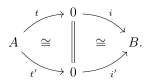
We shall sometimes write \(0\colon A\to B\) for a chosen null morphism \(A\to 0\to B\); one exists by the universal property of the bizero object.
Let \(\mathit{L}\) be a 2-category. A bizero object \(0\) in \(\mathit{L}\) is called strong if given any two parallel morphisms that factor through \(0\) there is a unique 2-cell between them, which is then equal to the isomorphism null 2-cell described in Remark 2.4. 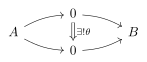
Let \(\mathit{L}\) be a 2-category with a strong bizero object, let \(n\colon A\to B\) be a null morphism and let \(x\colon A\to B\) be an arbitrary morphism. If some 2-cell \(\beta \colon x\Longrightarrow n\) is invertible, then it is the only 2-cell \(x\Longrightarrow n\).
Since the bizero object is strong, there is exactly one 2-cell between any two parallel morphisms that factor through \(0\). Applied to \(n\) and \(n\) themselves, this says that the only 2-cell \(n\Longrightarrow n\) is \(\operatorname {id}_{n}\). Let now \(\gamma \colon x\Longrightarrow n\) be any 2-cell. Then \(\gamma \cdot \beta ^{-1}\) is a 2-cell \(n\Longrightarrow n\), so that \(\gamma \cdot \beta ^{-1}=\operatorname {id}_{n}\) and hence \(\gamma =\beta \).
In a 2-category with a strong bizero object, a morphism admits at most one invertible 2-cell to a given null morphism. In particular, any two invertible 2-cells \(x\cong 0\) with the same codomain coincide.
Any two bizero objects in a 2-category are equivalent: if \(0\) and \(0'\) are both bizero, the essentially unique morphisms \(0\to 0'\) and \(0'\to 0\) are mutually inverse equivalences, since all hom-categories to and from a bizero object are equivalent to \(\mathsf{1}\). In particular, a morphism factors through \(0\) if and only if it factors through \(0'\), so the class of null morphisms is independent of the choice of bizero object. It follows that if \(0\) is a strong bizero object then so is every bizero object: a 2-category either has all its bizero objects strong, or none of them.
An object \(N\) of a bipointed 2-category is trivial when its identity morphism \(\operatorname {id}_{N}\) is isomorphic to a null morphism.
An object is trivial if and only if it is equivalent to a bizero object. Indeed, if \(\operatorname {id}_{N}\cong i\circ t\) with \(t\colon N\to 0\) and \(i\colon 0\to N\), then the parallel morphisms \(t\circ i\) and \(\operatorname {id}_{0}\) both factor through \(0\), so they are isomorphic, and \(t\) and \(i\) are mutually inverse equivalences; the converse is immediate. We take the condition on \(\operatorname {id}_{N}\) as the definition because it is the form in which triviality is used: it turns every question of triviality into a question about a single morphism being null, and those are settled by the reflection properties of Section 2.12.
Let \(h\colon B\to C\) be a morphism in a bipointed 2-category. We say that \(h\) reflects null morphisms if whenever a composite \(A\xrightarrow []{f}B\xrightarrow []{h}C\) is isomorphic to a null morphism, then also \(f\) is isomorphic to a null morphism. If \(h\) satisfies the dual condition, we say that \(h\) coreflects null morphisms.
2.12 2-monomorphisms and 2-epimorphisms
Let \(\mathit{L}\) be a 2-category with a strong bizero object, and let \(f\) be a morphism in \(\mathit{L}\). We call \(f\) a 2-monomorphism if it is a fully faithful arrow, that is, if for every object \(Z\) the functor \(f\circ (-)\colon {\mathit{L}}\left({Z},\, {A}\right)\to {\mathit{L}}\left({Z},\, {B}\right)\) is fully faithful. Dually, we call \(f\) a 2-epimorphism if it is a cofully faithful arrow.
A 2-monomorphism is, in particular, a monomorphism up to isomorphism 2-cells. More precisely, let \(m\colon A\to B\) be a 2-monomorphism and let \(u\), \(v\colon M\to A\) be such that \(m\circ u\) is isomorphic to \(m\circ v\). Then \(u\) is isomorphic to \(v\), since fully faithful arrows lift isomorphism 2-cells to isomorphism 2-cells. 2-epimorphisms satisfy the dual condition.
Note that even if we knew that \(m\circ u\) is precisely equal to \(m\circ v\), we could still only conclude that \(u\) is isomorphic to \(v\). As a corollary of the above, the discretisation of a 2-monomorphism is a monomorphism, and dually for 2-epimorphisms.
For a morphism \(q\colon A\to Q\) in a 2-category \(\mathit{L}\), the following conditions are equivalent:
\(q\) is an equivalence;
for every object \(Z\), the functor \((-)\circ q\colon {\mathit{L}}\left({Q},\, {Z}\right)\to {\mathit{L}}\left({A},\, {Z}\right)\) is an equivalence of categories;
for every object \(Z\), the functor \(q\circ (-)\colon {\mathit{L}}\left({Z},\, {A}\right)\to {\mathit{L}}\left({Z},\, {Q}\right)\) is an equivalence of categories.
If \(q\) is an equivalence with quasi-inverse \(p\), then whiskering with \(p\) provides a quasi-inverse for each of the two functors, so that (i) implies both (ii) and (iii).
Assume (ii). Taking \(Z=A\), essential surjectivity of \((-)\circ q\) applied to \(\operatorname {id}_{A}\) yields a morphism \(p\colon Q\to A\) together with an invertible 2-cell \(p\circ q\cong \operatorname {id}_{A}\). Whiskering it with \(q\) on the left gives an invertible 2-cell
Taking \(Z=Q\), the functor \((-)\circ q\) is fully faithful, and a fully faithful functor lifts invertible 2-cells to invertible 2-cells; the displayed 2-cell is therefore reflected to an invertible 2-cell \(q\circ p\cong \operatorname {id}_{Q}\). Hence \(q\) is an equivalence, and (ii) implies (i). The implication from (iii) follows by duality.
In a 2-category with a strong bizero object, every 2-monomorphism reflects null morphisms. Dually, every 2-epimorphism coreflects null morphisms.
We prove the first statement; the second one follows by duality. Let \(m\) be a 2-monomorphism and consider a composite \(A\xrightarrow []{f}B\xrightarrow []{m}C\) that is isomorphic to a null morphism, via a 2-cell 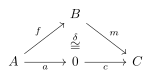 We prove that then also \(f\) is isomorphic to a null morphism. Since \(0\) is a bizero object, there exists a morphism \(i\colon 0\to B\). Moreover, the composite \(0\xrightarrow []{i}B\xrightarrow []{m}C\) is isomorphic to \(0\xrightarrow []{c}C\), by the universal property of the bizero object. Pasting the two isomorphism 2-cells that we have, we obtain an isomorphism 2-cell of the form
 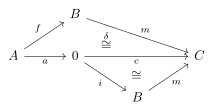 Thus \(m\) equalises \(f\) and \(i\circ a\) up to an isomorphism 2-cell. By Remark 2.14, we conclude that \(f\) is isomorphic to the null morphism \(i\circ a\).
2.17 2-kernels and 2-cokernels
Let \(\mathit{L}\) be a 2-category with a strong bizero object \(0\). A 2-kernel of a morphism \(A\xrightarrow []{f}B\) in \(\mathit{L}\) is a morphism \(K\xrightarrow []{k}A\) together with an isomorphism 2-cell 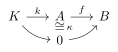 such that:
for every morphism \(Z \xrightarrow []{z} A\) and every isomorphism 2-cell
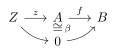 there exist a morphism \(Z \xrightarrow []{u} K\) and an isomorphism 2-cell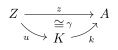
for all morphisms \(u\), \(v\colon Z \to K\) and every 2-cell
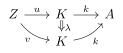 there exists a unique 2-cell \(\mu \colon u \Rightarrow v\) such that \(k \star \mu = \lambda \).
Here \(\star \) denotes the whiskering of a morphism with a 2-cell.
Let \(\mathit{L}\) be a 2-category with a strong bizero object \(0\). A 2-cokernel of a morphism \(A\xrightarrow []{f}B\) in \(\mathit{L}\) is a morphism \(B\xrightarrow []{q}Q\) together with an isomorphism 2-cell 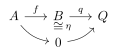 such that:
for every morphism \(B \xrightarrow []{z} Z\) and every isomorphism 2-cell
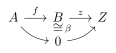 there exist a morphism \(Q \xrightarrow []{u} Z\) and an isomorphism 2-cell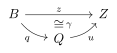
for all morphisms \(u\), \(v\colon Q \to Z\) and every 2-cell
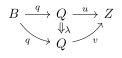 there exists a unique 2-cell \(\mu \colon u \Rightarrow v\) such that \(\mu \star q = \lambda \).
A 2-kernel is presented above as a morphism \(k\) together with an invertible 2-cell \(\kappa \colon f\circ k\cong 0\). By Lemma 2.6 there is at most one such 2-cell, so being a 2-kernel is a property of \(k\) rather than extra structure on it; dually for 2-cokernels. For the same reason, condition (1) needs no clause relating \(\gamma \) to \(\beta \) and \(\kappa \): any compatibility one might think to impose is an equation between two invertible 2-cells \(f\circ z\Longrightarrow 0\), and Lemma 2.6 supplies it.
In a 2-category with a strong bizero object, 2-kernels are 2-monomorphisms and 2-cokernels are 2-epimorphisms.
Let \(k\colon K\to A\) be a 2-kernel. To say that \(k\) is a 2-monomorphism is to say that for every object \(Z\) the functor \(k\circ (-)\colon {\mathit{L}}\left({Z},\, {K}\right)\to {\mathit{L}}\left({Z},\, {A}\right)\) is fully faithful; that is, that for all \(u\), \(v\colon Z\to K\) whiskering with \(k\) is a bijection from the 2-cells \(u\Rightarrow v\) to the 2-cells \(k\circ u\Rightarrow k\circ v\). This is exactly condition (2) of Definition 2.18. Dually, condition (2) of Definition 2.19 shows that every 2-cokernel is cofully faithful.
2-kernels and 2-cokernels are unique up to equivalence. Moreover, if \(f\), \(g\colon A\to B\) and there is an isomorphism 2-cell \(f\cong g\), then a 2-kernel of \(f\) is a 2-kernel of \(g\), and dually.
Let \(k\colon K\to A\) and \(k'\colon K'\to A\) both be 2-kernels of \(f\). Applying condition (1) of Definition 2.18 for \(k'\) to the morphism \(k\), which carries an invertible 2-cell \(f\circ k\cong 0\), produces \(u\colon K\to K'\) with \(k'\circ u\cong k\); symmetrically we obtain \(v\colon K'\to K\) with \(k\circ v\cong k'\). Then \(k\circ v\circ u\cong k'\circ u\cong k\cong k\circ \operatorname {id}_{K}\), and \(k\) is a 2-monomorphism by Proposition 2.21, so \(v\circ u\cong \operatorname {id}_{K}\) by Remark 2.14; symmetrically \(u\circ v\cong \operatorname {id}_{K'}\). Hence \(u\) is an equivalence. The second assertion holds because the defining data of a 2-kernel of \(f\) and of a 2-kernel of \(g\) are carried into one another by pasting with the given invertible 2-cell \(f\cong g\). The statements for 2-cokernels are dual.
As explained in [ 5 , Definition 2.20 and Proposition 4.11 ] , the canonical 2-ideal associated to a 2-category with a strong bizero object is closed in a 2-dimensional sense: 2-kernels reflect null morphisms and 2-cokernels coreflect them, in the sense of Definition 2.11. By Proposition 2.21 and Proposition 2.16 this holds more generally for every 2-monomorphism and every 2-epimorphism.
In a 2-category with a strong bizero object, a 2-monomorphism has trivial 2-kernel. Dually, a 2-epimorphism has trivial 2-cokernel.
Let \(m\colon A\to B\) be a 2-monomorphism with 2-kernel \(n\colon N\to A\). The composite \(m\circ n\) is isomorphic to a null morphism, and \(m\) reflects null morphisms by Proposition 2.16, so \(n\) is isomorphic to a null morphism. Then \(n\circ \operatorname {id}_{N}=n\) is isomorphic to a null morphism, and \(n\), being a 2-kernel, is itself a 2-monomorphism and so reflects null morphisms as well; hence \(\operatorname {id}_{N}\) is isomorphic to a null morphism, which is to say that \(N\) is trivial. The dual statement follows by duality.