7 Naturality
7.1 Pure configurations and their morphisms
A pure configuration is a morphism of short 2-exact sequences whose middle component is an identity: a pair of short 2-exact sequences
through a common object \(Y\), together with 1-cells \(f\colon A\to X\) and \(h\colon C\to Z\) and invertible 2-cells
Its dinversion is \(b\circ c\colon X\to C\).
Let \(\Pi \) and \(\Pi '\) be pure configurations, with data written as above and primed. A morphism of pure configurations \(\pi \colon \Pi \to \Pi '\) consists of a morphism of short 2-exact sequences \((\pi _A,\pi _Y,\pi _C)\) from the top row of \(\Pi \) to the top row of \(\Pi '\) and a morphism of short 2-exact sequences \((\pi _X,\pi _Y,\pi _Z)\) from the bottom row of \(\Pi \) to the bottom row of \(\Pi '\), with the same middle component \(\pi _Y\). We write
for the four filling 2-cells.
A morphism of pure configurations \(\pi \colon \Pi \to \Pi '\) induces unique invertible 2-cells
compatible with \(\theta _f\), \(\theta _h\) and the four filling 2-cells, in the sense that
Pasting the available 2-cells gives
using \(\pi _c\), \(\theta _f\), \(\pi _a\) and \(\theta '_f\) in that order. Since \(c'\) is a 2-monomorphism, being a 2-kernel, this invertible 2-cell is reflected, uniquely, to an invertible 2-cell \(\pi _f\colon \pi _X\circ f\cong f'\circ \pi _A\), by Remark 2.14; the displayed equation is the statement that \(\pi _f\) is that reflection, and it determines \(\pi _f\).
Dually, pasting \(\pi _b\), \(\theta _h\), \(\pi _d\) and \(\theta '_h\) gives
and \(b\) is a 2-epimorphism, being a 2-cokernel, so this is coreflected uniquely to \(\pi _h\).
7.5 2-naturality of the comparison
Let \(\pi \colon \Pi \to \Pi '\) be a morphism of pure configurations in a homologically self-dual 2-category. Then there is a unique invertible 2-cell
compatible with the characterising 2-cells of \(j_\Pi \) and \(j_{\Pi '}\), in the sense that whiskering \(\nu _\pi \) by \(2\text{-}\mathrm{coker}(f)\) on the right and by \(2\text{-}\mathrm{ker}(h')\) on the left produces the identity 2-cell of \(\pi _C\circ b\circ c\) under the two pastings displayed in the proof.
Whisker the two 1-cells \(j_{\Pi '}\circ \underline{\pi }_f\) and \(\overline{\pi }_h\circ j_\Pi \), both from \(2\text{-}\mathrm{Cok}(f)\) to \(2\text{-}\mathrm{Ker}(h')\), by the 2-epimorphism \(2\text{-}\mathrm{coker}(f)\) on the right and the 2-monomorphism \(2\text{-}\mathrm{ker}(h')\) on the left. Each of the two resulting 1-cells \(X\to C'\) is canonically isomorphic to \(\pi _C\circ b\circ c\). Indeed, on the one hand
using in turn the defining 2-cell of \(\underline{\pi }_f\), the characterisation of \(j_{\Pi '}\), the 2-cell \(\pi _c\) and the 2-cell \(\pi _b\); and on the other hand
using the defining 2-cell of \(\overline{\pi }_h\) and the characterisation of \(j_\Pi \).
Composing the first with the inverse of the second gives an invertible 2-cell between the two whiskered 1-cells. Now whiskering with the 2-monomorphism \(2\text{-}\mathrm{ker}(h')\) on the left and with the 2-epimorphism \(2\text{-}\mathrm{coker}(f)\) on the right is fully faithful in each variable, by Definition 2.13, so the 2-cell just constructed is the image of a unique 2-cell \(\nu _\pi \colon j_{\Pi '}\circ \underline{\pi }_f\Longrightarrow \overline{\pi }_h\circ j_\Pi \); and \(\nu _\pi \) is invertible because its image is. Uniqueness with the stated compatibility is the injectivity half of the same full faithfulness.
The proof uses homological self-duality only to know that \(j_\Pi \) and \(j_{\Pi '}\) exist; that they are equivalences plays no part. What it does use, essentially, is that the comparison is characterised by its triangle, which is the content of the uniqueness clause of Lemma 4.27.
7.8 2-naturality of the snake sequence
A morphism of ladders \(p\) between two diagrams of the shape 6.9, as in Figure 1, consists of 1-cells \(p_A\), \(p_B\), \(p_C\), \(p_X\), \(p_Y\), \(p_Z\) together with invertible 2-cells filling the four horizontal squares and the three vertical ones, subject to the compatibility of Lemma 7.4 on each of the two ends.
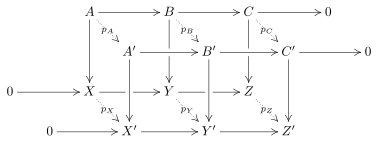
Let \(p\) be a morphism of ladders between two diagrams satisfying the hypotheses of Theorem 6.9. Then \(p\) induces 1-cells
on the 2-kernels of \(f\), \(g\), \(h\) and the 2-cokernels of \(f\), \(g\), \(h\) respectively, and the resulting ladder
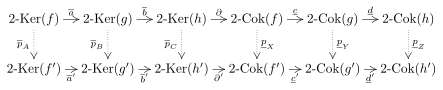
commutes up to invertible 2-cells. In particular there is an invertible 2-cell
The four squares not involving \(\partial \) are immediate. For the first, both \(\overline{p}_B\circ \overline{a}\) and \(\overline{a}'\circ \overline{p}_A\) become the same 1-cell after composition with the 2-monomorphism \(2\text{-}\mathrm{ker}(g')\): the defining 2-cells of the four induced 1-cells and the 2-cell filling the square \(p_B\circ a\cong a'\circ p_A\) paste to
and Remark 2.14 reflects this to an invertible 2-cell \(\overline{p}_B\circ \overline{a}\cong \overline{a}'\circ \overline{p}_A\). The second square is the same argument with \(b\) in place of \(a\), and the last two are dual.
For the square involving \(\partial \), recall from 6 that \(\partial =2\text{-}\mathrm{ker}(\underline{c})\circ z\circ 2\text{-}\mathrm{coker}(\overline{b})\), with \(z=z_3\circ z_2^{-1}\circ z_1\) the composite of the comparisons of the three pure configurations of Section 6.8. The morphism \(p\) induces a morphism of pure configurations between each of those three and its primed counterpart. For the first, the four filling 2-cells are: on the top row, the 1-cell \(I\to I'\) obtained from the uniqueness of the normal image factorisation of \(b\circ 2\text{-}\mathrm{ker}(g)\), by Proposition 3.22, together with the induced 1-cell \(Q\to Q'\) on 2-cokernels; on the bottom row, \(\overline{p}_C\) and the induced 1-cell \(2\text{-}\mathrm{Im}(h)\to 2\text{-}\mathrm{Im}(h')\); the middle component is \(p_C\) in both. The other two configurations are handled in the same way, the third using in addition the induced 1-cells on \(2\text{-}\mathrm{Im}(f)\) and \(2\text{-}\mathrm{Im}(g)\).
Theorem 7.6 applied to each of the three yields invertible 2-cells relating \(z_1\), \(z_2\), \(z_3\) to their primed counterparts, and hence, inverting the one for \(z_2\), an invertible 2-cell relating \(z\) to \(z'\). What makes the three paste is that consecutive configurations induce the same 1-cell where they meet: the first and the second both induce a 1-cell on \(2\text{-}\mathrm{Ker}(t)\), the second and the third both induce one on \(2\text{-}\mathrm{Cok}(s)\), and in each case the two agree, being induced by the same universal property. Since \(2\text{-}\mathrm{coker}(\overline{b})\) and \(2\text{-}\mathrm{ker}(\underline{c})\) are likewise 2-natural—being the 1-cells induced on a 2-cokernel and on a 2-kernel, so that the argument of the first paragraph applies—pasting the three squares gives the invertible 2-cell \(\underline{p}_X\circ \partial \cong \partial '\circ \overline{p}_C\).
By Remark 6.15 the 1-cell \(\partial \) is determined only up to an invertible 2-cell, so Theorem 7.10 is a statement about any choice of \(\partial \) and \(\partial '\): transporting along those invertible 2-cells carries the naturality 2-cell of one choice to that of another. What makes the statement possible at all is that Lemma 4.27 names its comparison and pins it down up to a unique invertible 2-cell.